There is perhaps no better way to reveal the hypocrisy among people who consider themselves to be “friends of the Earth” than to bring up the subject of air travel. For that reason, I suspect many readers of this post will quickly tune out – they don’t want to hear or think about it. Nevertheless, the significant contribution of air travel to climate change is absolutely clear and needs to be understood whether we like it or not. Therefore, my objective in this post is to provide an overview of the problem with a summary of the changes required if we hope to address it.
The contribution of air travel by air craft constitutes at least 5% of the total impacts of human activity on global warming and is rapidly rising (see davidsuzuki.org/issues/climate-change/science/climate-change-basics/air-travel-and-climate-change). Part this warming effect is due to the CO2 emissions of jet aircraft and part of it is due to their emissions of water vapor which in the cold air at high altitudes immediately condenses into heat-trapping clouds commonly known as jet contrails. While these contrails also have a slight cooling effect due to their weak reflection of incoming solar radiation, that effect is operative only during daylight hours.
A very large portion of those total miles travelled by aircraft are optional and/or unnecessary and the unnecessary component is increasing by 5 to 10% every year due to increasing incentives to fly and advertising campaigns that have become integral components of our lifestyles. Boasting rights prompted by the common greeting “what have you been up to lately” now go to those who can report on the most interesting or exotic excursion undertaken during their last spring break or long weekend. Thus, unnecessary air travel is now one of our most “out of control” as well as “most preventable” contributions to global warming.
The reasons behind the explosion in air travel
Over 130 airlines now have frequent flyer programs based on miles or points accumulated. Globally, several hundred million people participate in these programs. The benefit to airline companies is the habituation of people to air travel. Concerning business travel, the ease of both domestic and international air travel and the fact that the costs are typically met by our employers, means that globe trotting to conferences is now regarded as a perk of the job – by which the frequent flyer points also accrued provide additional personal trips. In this way, bottom-up pressure is created within a firm or government agency for what is now an obscene amount of unnecessary travel relative to a few decades ago. In addition, by using an airline-sponsored credit card to pay one’s household or business expenses, frequent flyer points can also be racked up quickly even by those of us who would otherwise not fly at all.
Another huge contribution to unnecessary long-distance air travel is now the widespread encouragement of myriad pleasure or educational excursions by various organizations and persons – including many that consider their programs to be environmentally progressive and enlightening. While examples of this abound everywhere, I will offer as examples two of my favorite “institutions” in Minnesota. One of these the college I went to and another is associated with my favorite radio program.
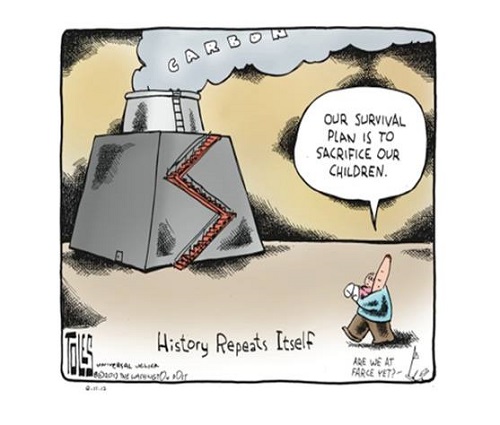
Take a look at the wide range of travel programs for students and alumni offered by my alma mater, St. Olaf College of Northfield, Minnesota, at http://wp.stolaf.edu/studytravel/. I completely understand the time-honored benefits of travel and why StO is so proud of their studies abroad programs. What troubles me, however, about such programs today is that the bill for the environmental damage done by these carbon-intensive trips is being deferred to future generations – rather than being paid for now by its users. This leads me to wonder: Does St. Olaf College not know about the exceedingly urgent need to reduce and eliminate all combustion of fossil fuels within the next several decades? Does it not know that the amount of CO2 in our atmosphere is already more than 40% greater than the natural level that existed prior to mankind’s extensive use of fossil fuels for energy production? Does it not know that because of the accumulation of CO2 emissions over the Industrial Age, we have painted ourselves into a very small corner with respect to allowed future emissions of CO2? Or does St. Olaf College think it has earned exemptions from cuts in these emissions because of all the “good things” it also does? For example, does StO think that their construction of solar panels and windmills on their campus gives them a pass on their other high carbon footprint activities? And finally, does StO not have science programs on its campus that would inform its administration of these now well-known environmental concerns?
I have tried, but failed to get a satisfactory answer to these questions from representatives of StO. In the absence of them, I can only guess that the answer is either good old sloth (the sin of avoiding responsibilities) or “but everyone else is doing it so why shouldn’t we”, or “but our contribution to the total problem is so small”. Whichever the answer is, the example set by St. Olaf College for environmentally sustainable methods of travel by its students, alumni, and the general public is a very poor one.
In order to fully understand the magnitude of this problem, it is necessary to realize that StO’s story is multiplied a thousand-fold by similar travel programs offered by other colleges, universities, and private organizations. All of these compete in offering the best experiences abroad they can arrange for their students, alumni, and customers. The public has historically looked to its universities and colleges for setting examples of advanced insight in how to successfully address society’s problems. By ignoring the environmental downsides of their existing travel programs, these colleges are doing the opposite relative to what actually needs to be done – right now and within the present decade. It is much too late in this game for these colleges to boast that their travel programs are preparing its students for addressing the global warming problem later. What we do in the present decade is far more important than what we do in the next – when the game might already be over. Note that the level of CO2 in our atmosphere is still increasing every year by about 2 parts per million. Yes, the world has not yet even leveled its man-caused emissions – partly due to the increase in air travel being discussed here.
Travel programs such those offered by St. Olaf College are particularly well designed for the relatively well off and elite classes of the USA and for this reason are also very popular within the public sector. By picking on another Minnesota institution named Garrison Keillor, another good example is provided. You can sign up for one of his travel excursions at Prairie Home Companion Cruises. (see www. prairiehome.publicradio.org/features/cruise/ ). Garrison is a self-professed progressive liberal whose strong support of various causes is, in the main, in harmony with my own. Like that of most of his kindred spirits within the intellectual elite class, however, he appears to ignore his travel program’s contribution to atmospheric CO2. Again, trips such as those he offers might have been harmless in days of yore before we painted ourselves into a tiny corner with respect to mankind’s allowed future emissions of greenhouse gases. I suspect that Garrison knows this and I would love to see him adjust accordingly. We are in desperate need of examples of appropriate behavior by members of our elite classes who could afford several extensive trips per year. The desperate straits in which the world now finds itself was greatly facilitated by the bad habits set in motion by the elite classes of the Western democracies. So why shouldn’t they be a big part of the solution rather than a huge component of the problem?
I think I would be much more inclined to take a bet on the prospect for turning Garrison Keillor than one on doing the same at St. Olaf College. Our private colleges are so tightly tied to our existing business-as-usual financial powers – from which our colleges receive financial support – that they undoubtedly have little leeway in following up forcefully on some of the moral obligations they might feel. That is, they are now typically “businesses” themselves with a “go along to get along” business model rather that intellectual leaders capable of going against the financial grain if reason suggests they should. Only after an issue is relatively settled within the public sector (as occurred after the civil rights battles of the 1960’s) will the colleges typically jump with both feet into what they consider to be a “controversial” issue. Thus, the administrations of our colleges and universities are far more likely to become good “followers” than good “leaders” of needed societal changes. They can sometimes be led to hop on a progressive bandwagon when forced to do so by student protests that they cannot control. Unfortunately, we appear to be living in an era of excessively “well-behaved” student bodies, many of whom don’t even seem to realize that it is their future families that are primarily at risk.
On the future of air transport
The only way I can envision environmentally responsible air transport in the future is by use of another type of transportable fuel. Specifically, that fuel would be some type of biofuel, the combustion of which does not change the total carbon content of the biosphere. This might be a biodiesel or ethanol, for examples, made from plants. It must also be acknowledged, however, that it would be very difficult to make enough of these biofuels as to duplicate the amount of fossil fuels being used today for air transport. Also, the use of plants for biofuel production would compete with our existing methods of food production. Thus, these biofuels would be in much shorter supply and considerably more expensive than our abundance supplies of fossil fuels. With a stiff carbon fee also applied to any continued use of fossil fuels, air transport would then be considerably more expensive and, therefore, readily available only to the fraction of today’s users. The rest of us would have to use the lower cost, low carbon footprint, and slower means of surface transport driven by either biofuels, renewable electricity, and conceivably even small nuclear reactors on trains. While some of these changes would be considered inconvenient, they simply must be made if we value sustainability and the preservation of our life-supporting environment. Note, however, that the long-awaited development of fast surface transport throughout the USA might then finally occur, making life more convenient for all of us. Note also that greatly reduced travel by high elevation aircraft would also reduce the formation of high elevation jet contrails which, of course, would be formed by the combustions of biofuels as well as petrofuels. By allowing high altitude flying only during the daylight hours, the slight cooling effect of sunlight reflection off the contrails would help negate some of the warming effect of those contrails.
But finally, some “good news” (I would like to think) for my alma mater. If the above changes in air transport could be made, the costs of St. Olaf’s wonderful international travel programs would no longer be deferred to future generations of Oles. Instead, those programs would be paid for immediately by their present users. Sounds fair and in harmony with the Christian ethical principles on which many of our nation’s colleges such as StO were founded, does it not? Yes, all of this constitutes more of a moral dilemma today rather than a technical one, does it not? My hope is that St. Olaf College finds the strength needed to do the right thing – even if their donations from the fossil fuel users and providers might be diminished. As King Olaf II’s men shouted at the Battle of Stiklestad in 1030, “Fram! Fram! Kristmenn Krossmenn” (English translation: “let’s get on with it!”)



 ericgrimsrud