Uffda!! Once again (see my May of 2015 post entitled “The disconnect between modern climate science and St. Olaf College, for example”), it appears that I am about to pick on St. Olaf College as an example of an institution that could provide more leadership in an era when bold and revolutionary changes are needed – if we want future generations to enjoy opportunities that are anywhere close to those my generation had.  Born in 1944, my spouse, Kathy, and I are about to celebrate the 50th anniversary of our graduation from St. Olaf College with the class of 1966.  My classmates and I lived in what could be called a “Goldilocks” era of the USA.  With the Great Depression and WWII behind us, we had carpets of opportunity laid out before us in all directions and most of us prospered with relative ease.  When the industrial forces of America turned from the production of war materials to commercial goods in the ‘50’s, we helped out by becoming good and even insatiable consumers of those goods.  For the energy needed to propel those lifestyles, we had literally unlimited supplies of cheap fossil fuels and still do.  Meanwhile the total population of the Earth continued to rise exponentially – at seven billion today, it is expected to be nine billion by midcentury.

Before even mentioning our now obvious global warming problem, let’s first recall that back in 1968, just after the graduation of my class at St. Olaf, Stanford Professor Paul Ehrlich published a best-selling book entitled “The Population Bomb” in which he warned us about the detrimental effects of our increasing population on the physical conditions of our planet. While his dire predictions of starvation in the ‘70s and ‘80s did not come to be due to subsequent improvements in agriculture, Ehrlich’s prediction now does seem to be bearing down on us for a different, but related reason  –  that is, the changes in climate caused by the greenhouse gas emissions of all of those people.  While the concentration of CO2 in our atmosphere had not exceeded 290 ppm for about three million years, about 100 years ago it started to climb and is now over 400 ppm.

So we were warned about problems such as these way back in 1968 and in more recent decades have been warned countless times by a countless number of climate scientists that we have now reached a limit of planet sustainability because of our past and continuing emissions of CO2 via the combustion of fossil fuels.

So the obvious next question is: what have we been doing about it? And the answer is:  relatively little, as is directly evidenced by the only score card that matters – our background level of CO2 in the atmosphere.  It is now rising even faster than ever –  by more than 2 ppm in each of the last two years.  It has never previously risen so rapidly.  Thus, our background CO2 level is now approaching 404 ppm, a level not seen for over 10 million years. The only thing we have going for us at the moment is the thermal inertia of the Earth – its takes a decade or two to see the full effects of changes in the magnitude of the Earth’s warming by the greenhouse gases.  We have to get our CO2 level down ASAP, not let it continue to increase.

In order to turn things around, national and international leadership of a revolutionary nature is now required. There is no longer adequate time for testing incremental changes that might have been helpful if tried 30 years ago. Building more wind and solar mills will help, of course, but by far, the more important low-hanging fruit that we know will work and absolutely must be harvested ASAP is related to huge CONSERVATION changes spelled here with all caps and not simply “conservation” of the incremental and ordinary sense.  Note that solving the global warming problem means cutting ALL greenhouse gas emissions to ZERO within the next few decades. That goal cannot be accomplished by “all of the above” energy policies and requires that we go “cold turkey” on all fossil fuel use – thereby leaving it in the ground where it belongs and does no harm.

OK, now let’s get back to St. Olaf College – again, this is because it is my own alma mater with which I am somewhat familiar and also because it represents what’s happening at hundreds of other colleges and universities in the USA. Most of these colleges, like St. Olaf, might think they are “doing their part” in combating climate change mainly by increasing energy efficiencies on their campuses. Their remaining problem, however, is that they also choose to be an integral part of the USA’s non-sustainable system of fossil fuel consumption via some of their educational programs and endowment investments.  For example, one of St. Olaf’s most prized programs is its “studies abroad” programs – by which a sizeable fraction of its students take courses involving travel to all corners of the Earth.  No argument here:  there are great benefits to these hands-on, first-hand experiences.  The only problem is that fossil fuels are used to get those students and their teachers to and from those places.  In addition, St. Olaf College regularly invites its alumni to similar experiences abroad involving extensive fossil-fuel-driven transport.

Perhaps the most unfortunate aspect of these fossil fuel intensive activities is that they send the wrong message to students and alumni. Does St. Olaf College not recognize that there is no “good” or “ethical” CO2 emissions: all are equally bad.  If a college feels that it must offer these experiences to its students and alumni, they should tell the airlines involved that they will use their services only if their aircraft are powered by carbon neutral biofuels (even though biodiesel is more expensive than regular diesel).  In addition, is there any reason, other than increased expense, why the transport of St. Olaf’s student-athletes to other colleges in the region could not be provided by biodiesel-powered busses, vans and cars.  Is it right for St. Olaf College to have future generations pay for its fossil fuel intensive programs?  If you need something now, shouldn’t it be paid for now, as you use it, instead of passing that bill forward to your grandchildren? At any ethical level, I should think the answers to those two questions are no and yes, respectively.

Therefore, I would like to encourage St. Olaf College to take the opportunity it now has to significantly increase its leadership role on the most important issue of our time. In a recent publication from St. Olaf, the college was able to boast about its involvement some 50 years ago in the civil rights movement of the American South. Some of my own classmates jumped into the midst of that conflict. The forces on the other side of that racial issue were strong and determined.  Considerable courage was required of those St. Olaf students.  One St. Olaf graduate was killed in Selma.  In terms of the future well-being of mankind, the dangers posed by global warming are at least as great as those posed by racial inequality and the courage needed to fight the former is just as great as the latter.  Nevertheless, I hope that in 50 years hence, St. Olaf College can again boast about a leadership role it played in preserving physical conditions on this planet.  By that time the ravages of global warming are sure to be somewhere between substantial and horrific. In the meantime, the only variable mankind has any control over is its cumulative CO2 emissions and St. Olaf College could provide a better example to its students, alumni and other colleges of how to better address this central point.

In order to facilitate the endorsement of these ideas at St. Olaf College, I have done my best to contact its President, its Board of Regents, its Environmental Science faculty and its student newspaper.
Posted by: ericgrimsrud | April 14, 2016

Hillary’s approach no good for addressing climate change

Hillary Clinton appears to have the inside track not only on the Democratic nomination but also on the Presidency largely because of her skill in applying her “method” to potential voters. By my use of that term, I am referring to her ability to seek what appear to be “win-win” outcomes for both sides of an issue.  Thus, she is not automatically dismissed by either side and becomes preferable to those candidates with more extreme views and insist on doing things the “one correct way”.  Thus, while supporting some legislation concerning climate change, she is also in support of programs favorable to the fossil fuel industries. Her strong support of fracking techniques discussed in my previous post is just one example.  Another is her hesitancy in promoting a stiff and annually increasing carbon tax.

In return for these moderate views on the subject of climate change, Hillary’s political career and Clinton Foundation have been generously rewarded with enormous contributions from the corporate sector of America, including Wall Street and the fossil fuel industries. Even Warren Buffet, owner of the BNSF railroads with strong ties to the coal industry, is one of her strongest supporters.  Given the overwhelming evidence emerging every day about the enormous problems being caused by global warming, I am guessing that another Clinton Presidency is the best many of these large and powerful corporations can do in order to stay in the fossil fuel business. So yes, Hillary’s record in arranging “win-win” outcomes on complex issues is the reason why she might win the Democratic nomination instead of Bernie Sanders.

But wait a minute. There is something very wrong with this picture.  What’s wrong is that on the specific issue of addressing climate change, a successful outcome cannot be one that is win-win.  A successful outcome requires that one side must lose big time. It requires that CO2 emissions be decreased to near zero in the next few decades because we have kicked that can down the road for too many past decades.  It requires that Hillary’s  “all of the above” attitude concerning methods of energy production be changed to “only the alternates”.  In the fight ahead, Hillary will be up against a much tougher Mama than she – Mother Nature, that is, who only does things one way – Her way – and Hillary will go down with all of the rest of us if she thinks her “win-win” methods will work in this case.

Everyone in the energy business knows what I have just said – including those tied to fossil fuels. Again their only hope of avoiding imminent financial setbacks and of staying in business for as long as possible is to find political representatives who will favor “all of the above” energy policies that provide their industries with as soft a landing as possible in the new world of greenhouse-gas-free energy production that we are all too slowly moving towards. And that representative has to be sufficiently well-regarded by the progressive and environmental communities of the USA as to enable her win-win proposals to sound viable to them.  Thus, Hillary is clearly “their man” on this issue and this fact will help her wrestle the Democratic nomination from Bernie Sanders.

What’s terribly wrong with this picture is that Bernie Sanders is the only one who recognizes that there must be a clear loser in our present fight over energy policy and we don’t have sufficient time left to gradually get it right. While Hillary would have been a strong candidate 10 or 20 years ago, she no longer is.  Only Bernie Sanders “gets it”.  During their amazing political careers, both of the Clintons have been masters at pandering to the public – that’s how Bill won his first Democratic nomination in 1992.  We can only hope that in Grandma Hillary’s twilight years, she comes to see that we no longer have any more time for pandering and delay on the issue of climate change.  We must try as hard as we can to kill the beast that is consuming us.

Thus, if Bernie could win the Presidency, we could look forward to going to work immediately and very forcefully on the problem of climate change. With Hillary as the more likely winner, we can still cross our fingers.  And heaven forbid, if any of the candidates from the other side of the aisle wins the Presidency, we would simply kick that can all the way down to our grandchildren with the enclosed message – Sorry kids, but we were just too busy having a “nice day”.

Posted by: ericgrimsrud | April 11, 2016

Even Obama and Clinton’s thinking is fatally “fracked”

President Obama and his former Secretary of State, Hillary Clinton, have been very pleased with the new American technique of “fracking” by which large deposits of coal and shale are essentially exploded underground thereby opening seams through which entrapped natural gas can escape and be harvested at the surface. Over the last few years these techniques have made the USA the number one supplier of low-cost natural gas and have enabled the USA to reduce its CO2 emissions from coal-fired power plants. Using natural gas instead of coal in those power plants results in about one-half as much CO2 emitted per energy unit produced.  Thus, the Obama administration has been able to boast about reducing CO2 emissions while simultaneously improving our economy.  With the assistance of our State Department and fossil fuel corporations, fracking techniques are now spreading to other countries as well.

Other than the fact that natural gas (largely methane) is also a fossil fuel – the use of which will eventually also have to be eliminated – what’s wrong with this picture? The answer is: a very great deal is wrong with this picture as is now being clarified by ongoing scientific studies and measurements.  Most importantly, a very recent study by Harvard scientists has shown that emissions of methane gas have greatly and uniquely increased over just the USA and all of this has occurred since the development of its fracking methods. These measurements indicate that roughly half of the total global emissions of methane are now coming from the USA’s relatively small portion of the total surface of the Earth.

This is exceedingly bad news with respect to the greenhouse gas warming expected in the upcoming next few decades. This is because, on a molecule-to-molecule basis, methane is at least 100 times more effective in trapping the Earth’s heat as is carbon dioxide over that several decade period.  Thus, if we can make the seemingly obvious assumption that methane emissions are being significantly increased by fracking techniques, it appears that fracking is negating any gains we are making via CO2 reductions.  It is even possible that fracking is making greenhouse gas warming worse than it was before its discovery and application.

This is a huge setback for politicians, such as Obama and Clinton, who have favored and boasted about “all of the above” approaches to energy production and especially about gas production via fracking. Going forward, we can only hope that they change their view very quickly.  When one gets down to the core of the matter, it becomes progressively clearer that “all of the above” attitudes must be changed to “only the alternates” which do not result in CO2 or CH4 emissions.

Only a stiff and annually increasing carbon tax can accomplish this – in spite of the best intentions of Obama and Clinton to address the climate change issue in a manner that does not require substantial changes in the business-as-usual forces that have defined our fossil-fuel-saturated lifestyles. It has been noted by this writer that of all of the candidates for the US Presidency in 2016, only Bernie Sanders has promoted a stiff carbon tax and the termination of fracking techniques.  If , as expected, Bernie does not win the Democratic nomination, I hope that he will at least manage to educate Hillary on this most important detail.  It has also been noted how very far the discussions among Republicans have been from this level of detail concerning the causes of climate change.  In short, they don’t have a clue about the science involved.

For more information on this topic, see Bill McKibbin’s recent article entitled “Global warming’s terrifying new chemistry” at http://www.thenation.com/article/global-warming-terrifying-new-chemistry/ This issue concerning methane leakage from fracking facilities is exceedingly important and might even surpass the effect of increased CO2 on global temperatures over the next few decades.

Posted by: ericgrimsrud | April 8, 2016

The “solution” offered by the Paris Accord

The Paris Accord of December 2015 was a document produced by an international set of politicians and scientists. Science and politics are a rough mix.  The latter wants to solve the problem of climate change in a manner that does not change lifestyles and the former wants to solve the problem in accordance with the laws of physics, chemistry, and nature.  Given these profound differences we should not have expected much of a substantial nature to have emerged from this group – and, indeed, it did not.  Nevertheless, let’s have a careful look at what did emerge.

The primary goal envisioned in the Paris Accord is to limit Industrial Age global warming to 2.0 degrees C at least and to 1.5 C, if possible. In addressing these goals, however, was also recognized, at least by the scientists in attendance, that neither will probably be attained simply by reducing our emissions of greenhouse gases, including carbon dioxide, methane, nitrous oxide and tropospheric ozone.  In fact, it was generally recognized that within the very next decade or two we will have most probably emitted enough of these greenhouse gases as to cause temperature rises above 2.0 degrees C.  If those business-as-usual practices then continued further into the 21st century, we would be headed towards a 3 to 6 degree warmer world.  Given those very possible occurrences, what were those delegates in Paris thinking when they signed off on this document?  That is, how could they suggest, with a straight face, that their goal is to limit future warming to 2.0 C and even 1.5 C?

The answer to that question is that they were assuming that by the second half of this century, we will have developed various means of man-caused “negative feedbacks” that counter and offset the man-caused “positive feedbacks” caused by our increased concentrations of greenhouse gases. In this case, a negative feedback is a change that would cause a cooling of the Earth. I suspect that the politicians in attendance might have bought into the reality of this term more than the scientists. In any case, these envisioned “negative feedbacks” were a part of the Paris plan but were not explained in any level of detail.

So it is now imperative that we understand what these negative feedbacks might be.  They would potentially be one of two possible types.  One would involve the  removal of the atmospheric greenhouse gases that cause global warming.  An example of such a technique would be to burn biofuels (i.e. wood) in power plants and then collect and bury the CO2 produced.  The great obstacles associated with such methods, however, are the sheer magnitude of these undertakings – rendering them financially untenable.

Another approach to man-caused negative feedback is via solar radiation modification (SRM) by which a larger portion of our incoming sunlight would be reflected back into outer space. Mother Nature already does this, of course.  About 30% of incoming solar radiation is naturally reflected (we call this fraction the “albedo” of the Earth) off reflective surfaces including highly reflective clouds and snow.  Because some of these SRM techniques are expected to be less expensive than greenhouse gas removal they seem to be receiving most of our attention.

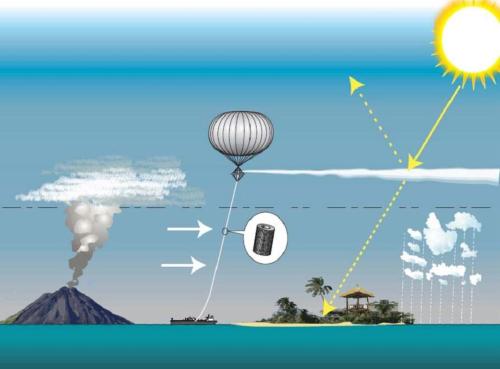
Among the envisioned methods of sunlight reflection, the one that appears to have received the most attention so far is illustrated in the following figure which shows how Mother Nature and potentially mankind can cause this reflection via the formation of sulfate particles in the Earth’s stratosphere.

image-20160216-19245-2ouvki

Whenever unusually powerful volcanic eruptions occur – such as that of Pinatubo in 1991- gaseous sulfur dioxide (SO2) is punched very high into the Earth’s stratosphere. Simultaneously, that sulfur dioxide is oxidized to involatile forms of sulfate that condense into particles.  An increased fraction of the incoming sunlight will then be reflected off those particles.  This, of course, will tend to cool the Earth.  For example, the Pinatubo eruption cooled the surfaces of the Earth by about 0.1 degrees C for two years after that single eruption. This cooling effect lasted for two years because it takes that long for small particles to be removed from the stratosphere by the pull of gravity. Thus, a predetermined amount of SO2 continuously added to the stratosphere could have a significant and long-lasting effect on the Earth’s surface temperatures.  The amount of SO2 injected and the magnitude of its cooling effect could be continuously adjusted as needed in order to obtain the average global surface temperatures desired.

As illustrated in the figure, gaseous SO2 could be emitted artificially into the stratosphere either by hydrogen-filled balloons as shown or by high altitude aircraft. By the same subsequent reactions as describe above, this would cause increase refection of sunlight and continuous cooling of the Earth. The fact that this process is expected to be relatively inexpensive seems to have given it the inside track among the man-caused negative feedback methods being considered.

But wait a moment, all means of climate modifications, including this one, have various potential downsides that must be very carefully considered before implementation on a large scale. Concerning the addition of SO2 into the stratosphere, these concerns include the following.

The Earth’ s stratosphere is a fragile region of our total atmosphere in which various chemical processes perform functions that are vital to what happens below and on the surface of our planet. In particular, incoming and otherwise deadly ultraviolet (UV) radiation is removed by stratospheric ozone (O3) and the concentration of O3 in the stratosphere can be diminished by the presence of other chemical substances artificially added to the stratosphere. This, for example, is what happened when mankind added chlorofluorocarbons (Freons) to the atmosphere – eventually leading to ozone loss and a ban on the use of CFCs. So we need to know how much damage, if any, would SO2 and its oxidation products do to the ozone layer if made long-term components of the stratosphere.  In addition, what would these added sulfate particles do to weather patterns throughout the Earth? And what might they do the stratospheric clouds in Antarctica that have been implications in formation of the “ozone holes” now annually observed there? In other words, would we really want the equivalent of a Pinatubo continuously blowing sulfate debris into the stratosphere?  We don’t know the answer to that question yet and would certainly want to know it before we implement this method on a grand scale.  This is an example of revealing “unintended” consequences – as we failed to do prior to our massive production and use of chlorofluorocarbons.

Another problem raised by this and other SRM plans are that they do not address the acidification of our oceans that is occurring due to increasing levels of atmospheric CO2. This problem is perhaps just as detrimental to forms of life in the seas as temperature increases are to those on land.  Ocean acidification would actually be enhanced by any SRM method that simultaneously allows CO2 levels to increase. Thus, it appears that eliminating the CO2 emissions of mankind would be the only way to address both of these problems.

Another issue sure to occur with intentional modifications of climate and weather would be of an international political nature. The nations of the world would certainly have different opinions concerning their choice of an “ideal” climate.  The country of Pakistan, for example, has been suffering from extreme weather events (flooding and warming) as a result of man-caused warming.  At the same time, some countries to their north, such as Russia, might not be so interested in lowering their average temperature.  Climate changes could cause some large regions with moderate levels of rainfall to become non-arable deserts. The great difficulties to be expected in making these command decisions at both national and the international levels cannot be overstated.

Finally, another problem associated with all methods of artificial climate modification is that they give the public the impression that “something can be done” about it leading to the conclusion that “we can fix it later” which, in turn, decreases our efforts to cut greenhouse gas emissions. This is a potentially fatal set of thoughts because we do not know if any of these envisioned negative feedback schemes will work satisfactorily. They might even cause greater environmental problems due to their unintended consequences.  And lastly, we only have one planet on which to perform these “experiments”.

I hope you now have a better understanding of the unsubstantiated assumptions inherent of the Paris Accord’s envisioned plan for addressing global warming. You might also now understand why I consider these climate modification plans to be unwarranted at the present time. The fact that these ideas constitute a major element of the Paris Accord suggests to me that too many of our political and scientific leaders are willing to reduce public angst today concerning this problem by passing the solutions to the problem off to the next generation. In this way, we continue to “feed the beast” (that is, our ultrahigh carbon lifestyles) and ignore our intergenerational responsibilities.  Sure, something will come up, right?  And in the meantime, “talking the talk” should be enough to be a credible member of our generation, right? !!  Unfortunately, politics and science might not turn out to mix at all well.

Posted by: ericgrimsrud | April 1, 2016

The other half of greenhouse gas warming

We are well aware of the amount of our major long-lived greenhouse gas, CO2, that has been emitted into our atmosphere. That quantity has been easy to track either from the amount of fossil fuels we burn each year and/or by direct measurements of CO2 in the atmosphere. We also know that there are at least two other permanent greenhouse gases in our atmosphere – methane (CH4) and nitrous oxide (N2O) – that also contribute significantly to global warming.  Although their concentrations in the atmosphere are much lower than that of CO2, on a molecule-to-molecule basis each of these are much stronger greenhouse gases – 28 times stronger than CO2 in the case of CH4 and 270 times stronger in the case of N2O.  Because the sources and sinks of these two GHG’s are more numerous and complex than those of CO2, it has been more difficult, to date, to estimate their quantitative effects on warming relative to that of CO2.

This has now been done, however, in a new study recently reported in Nature (a summary of it is available to the public at http://www.skepticalscience.com/global-food-production-overwhelm-efforts-combat-climate-change.html).  The answers they provide are that CH4 emissions are causing about 40% as much warming as the CO2 resulting from fossil fuel combustion and that N2O is causing about 20% as much. Most of the CH4 and N2O emissions are attributed to agricultural practices.  Methane is formed in the ruminant stomachs of livestock and in the anaerobic decay of their waste products as well as by rice cultivation in wetlands.  Nitrous oxide is produced from the application of nitrogen-based fertilizers and from the burning of plant and animal wastes.  By the conversion of forests to tillable fields, agricultural practices also add more CO2 to the atmosphere – enough to additionally heat the Earth by about another 30%.  Putting all of this together, the sobering conclusion is that present agricultural practices result in approximately the same amount of global warming as caused by the combustion of fossil fuels.  Note also that a significant fraction of our total fossil fuel combustion is dedicated to energy intensive aspects of agriculture including beef and fertilizer production.

Although this conclusion might not be surprising to scientists, the general topic has not received nearly enough attention in the past. Although it is hard enough to wean the world of its addiction to fossil fuel combustion, it is probably even more difficult to change its means of food production.  Agriculture without bovine cattle and nitrogen-rich fertilizers would constitute great changes in existing practices.

Nevertheless, it is becoming increasingly clear that we have two equally important challenges to face in the battle against climate change. One is how to power our multitude of activities by methods other than fossil fuel combustion and the other is how to feed ourselves by methods not involving bovine cattle and nitrogen-rich fertilizers.  Since I know many healthy, happy people that manage to do both of these things, it is clearly possible and would be made much easier for everyone to do if they had the help of an organized and wise government.  “But this is not going to happen”, I can already hear you say.  OK, then how about getting ready for a 4-degrees C warmer world with the sea covering all coastal cities and land.  All of this is frightening enough to turn a person into a denier of science and the forces of Mother Nature – which it is possibly doing at this moment.

Again, we need either much better/smarter people or a strong carbon tax. A stiff carbon tax will not only reduce our use of fossil fuels but will also discourage us from the use of energy intense means of food production – such as the production of beef and nitrogen-rich fertilizers. In the process, sure, someone’s favorite ox is going to get gored.  But we all know that we have to modify on our current “extravagant lifestyles” so that our grandchildren can manage to have “lives”.  “The tyranny of the contemporary” (see my post in March 2016) is, indeed, a terrible force that prevents us from acknowledging and honoring our intergenerational responsibilities.


Posted by: ericgrimsrud | March 27, 2016

The Four Horsemen of this Apocalypse

We are painfully aware of what we are doing to our atmosphere. It now contains over 40% more CO2 than it ever has in the last three million years and we are still adding more to it every year.  We also know that this man-caused excess CO2 will stay in the atmosphere for many centuries heating up the Earth for several millennia into the future. We also know that sea levels will be rising quickly in the current century rendering vast coastal regions and major coastal cities uninhabitable.  We also know that a warmer atmospheric carrying more water vapor will greatly increase the frequency of extreme weather events. We also know that global warming has weakened our Jet Stream thereby creating prolonged warmer and prolonged colder periods all across the Northern Hemisphere. We also know that 9 billion people will be living on our planet by midcentury and that massive levels of human migration and starvation will follow. We scientifically understand all of this and are also well aware of technical changes that could significantly reduce the chances of the most dire outcomes if we chose to aggressively combat the buildup of CO2 and other greenhouse gases.  Because of our past neglect we now also know that we need to cut man-caused emissions of CO2 to near zero within the next several decades.

In spite of all of this knowledge, our global annual emissions of CO2 have not yet begun to decrease. In fact, they are still increasing every year.  So why is this? How can mankind be so utterly foolish and irresponsible as to do this to his planet?  In pondering that question four reasons stand out to me.  I will call them the Four Horsemen of our Apocalypse because like those described in the Book of Revelations they promise to bring Pestilence, War, Famine, and Death.

The first of these is: but we can’t “afford” to address this problem – because doing so will do too much damage to our economy.  This line of reasoning is extremely common in our country today as evidenced by a column recently written by economist Robert J. Samuelson of the Washington Post.  For a full account of his column and my response to it, please see my post of  December 2015 entitled “Robert J. Samuelson needs to meet Mother Nature”.  While Samuelson acknowledges that man-caused global warming constitutes a very serious problem, he nevertheless argues that we can’t afford to change our business-as-usual dependence on fossil fuels because of the ill effects he believes that would have on our existing economy.  Apparently, he and many others think that a damaged economy would be worse than a 4 degrees C warmer world.  Alternatively, maybe Samuelson thinks that “something will come up” on the science and technology fronts that will save us from the ravages of warning – even though we do not yet know of any such safety net. While such thinking is scientifically insupportable, the notion that our economy is more important than our environment is widely shared by controlling forces of US business and government.

The Second Horseman of this Apocalypse is that the public thinks we are addressing the problem. This is partially due to the ubiquitous TV advertisements of the fossil fuel companies which erroneously assure us of this. Sadly, however, this same notion is also perpetrated by a large portion of our more environmentally conscientious politicians and even scientists who prefer to provide “good news” to the public rather than being appropriately blunt.  I have previously related these point on this website in a January 2016 post entitled “Yes, indeed, too many scientists are biased”.  While it is relatively easy to envision why politicians who want to be returned to office in the next election cycle pander to the public in this way, it is more difficult to understand why scientists are now “self –censoring” their own research – in an attempt to be on the same page as well-meaning politicians and sources of research funding. Thus, for example, the public has the impression that the recent Paris Accord on climate change produced a meaningful path forward that is supported by both civil and scientific authorities on the subject.  By decreasing angst among the public, the Paris Accord has possibly done more harm than good.

The Third Horseman of this Apocalypse is the notion that we cannot trust other nations. The elevated CO2 level we presently have in our atmosphere was created primary by the developed countries of the world during the Industrial Age.  It is the energy they derived from fossil fuel combustion that made possible most of the technological marvels they enjoy today.  In recent decades, the developing countries of the world, such as China and India, have been catching up. Their CO2 emissions are now just as large as those of the developed countries and are increasing as greater rate. Therefore, the challenge before us today is to convince the developing world that they should not “take their turn” in enjoying the energy that is still so readily provided by fossil fuels. Many in both the developed and developing countries have so little hope for the prospects of this notion, however, that they argue that it will fail and, therefore, there is no point in reducing their own emissions.  In short, the great spread of fossil fuel use throughout the world has caused many to believe that the problem can no longer be addressed, no matter what the developed countries do.  In short, many have no faith in the prospects for international cooperation concerning this as well as other issues.

Finally, the Fourth Horseman is the fact that our atmosphere provides a free-of-charge garbage dump for waste CO2. That is, we have still not done the obvious – assign a fee or carbon use tax to the production and combustion of fossil fuels – one that continuously increases each year until the emissions of CO2 have been driven down to near zero.  I have previously discussed this point also in several posts on this website such as “We need either much better people or a carbon tax” in October 2015 and “The NFPTFCPFM Energy Plan” in November 2014.  Obviously, our unconscionable means of CO2 waste disposal will continue to be used by fossil fuel users as long as it remains free of change.  In addition, this century-old gift to the fossil fuel producers has inhibited the development of the alternate, non-CO2-producing means of energy production.  Only by charging the full costs of all means of energy production can a level playing field be created in the energy sectors in which there would be no need for federal “gifts” to any energy producers.

Now let’s be brutally clear here about one important point. The overall object of an increasing carbon tax would be to drive CO2 emissions from fossil fuel use to near zero over the next few decades.  Yes, that does mean putting the fossil fuel companies out of the energy business.  Given that fact, are you still on board with the carbon tax concept or are you too wedded to fossil fuel use to go along with it?   And can you think of any industries or stock holders that might object to this overall objective?  Yes, indeed, resistance to this essential and eminently fair change in our tax laws constitutes the most formidable of our Four Housemen.

Others? There are other candidates for this Horsemen designation than can be envisioned, of course. But the ones that I can think of at the moment are merely the ever present foibles of mankind that underlie the ones I have listed above.  Foremost among these would be deficiencies in our respect for our environment and the forces of Mother Nature, deficiencies in our scientific acumen, and a moral lapse concerning our intergenerational responsibilities.  They say it helps to know who your real enemies are and we have indeed met them. They are these Four Horsemen of this Apocalypse who, by the way, are us.


Posted by: ericgrimsrud | March 11, 2016

An up-side to a Trump Presidency

In a previous post (July 2015), I provided my opinion concerning the relative merits of the two leading Democratic candidates for the Presidency, Hillary Clinton and Bernie Sanders, concerning the urgency of addressing the world’s greatest problem – climate change. In that comparison, I gave Bernie Sanders the nod and still do.  No other Presidential candidate understands the full gravity of this issue as much as Bernie does.  Since then, I have also carefully watched the Republican race in order to gauge the potential winner’s views on this issue and now that it seems very likely that Donald Trump will be that person, I will provide my assessment here of what we might expect from him if he makes it all the way to the White House.

Of all of the Republican candidates, it is most difficult to guess what Trump would do about climate change if elected. This is partially because the leadership of GOP has been AWOL on this topic over the last two decades and has put no pressure on its candidates to take the issue seriously. And even if the GOP had recommended some specific actions or non-actions on climate change, it is unlikely that Donald would pay much attention to them. The Donald has found great success in being a very loose cannon within the GOP and to the consternation of his party’s leaders has shown that he can take whatever view he wishes on all topics.  In short, the Donald has become bigger than the GOP itself.  Concerning the single issue of climate change, this could be a good thing since the GOP has done its very best to obstruct all actions concerning it.

So what would a President Trump decide to do, if anything, in order to address the problem of climate change? On one level Trump does not appear to be the socially conscientious and responsible type that we might think is needed for this task. He seems to be the very opposite of former President Carter, for example, who has devoted his life to the development of sustainable lifestyles throughout the world. On the other hand, Trump will not have his hands tied by a GOP establishment that has shown itself to be scientifically backwards on this issue.  I don’t believe that Trump is as dismissive of science and he very possibly might begin to see the magnitude and urgency of the problem more clearly than the GOP has. And Trump does not want the USA to be a loser if alternate means of energy production appear to be overtaking the old-fashioned methods.

In addition, Trump is not so heavily indebted to the fossil fuel industries for past donations as the GOP and other Republican candidates are. Also he is not wedded to any of the religious or political ideologies that render large portions of many Republican brains inoperative.  It is possible that he might even harbor a high level of respect for our scientific communities and be able and interested in learning a great deal of the associated science himself.  Thus, a President Trump might conceivably decide to do some good things even if doing so constitutes an about-face relative to previous GOP “leadership” on this issue.

So if the Donald does win the Presidency this year, I would cross my fingers and hope that he turns out to be very much better than his party has been. While Trump owes the GOP brand very little, he might be induced to help it enter the 21st Century with respect to modern science and environmental realities.  At the very least, we could be thankful that none of the other thoroughly fossilized brains of the GOP establishment made it into the White House.  It is very difficult, if not impossible, to change the minds of religious or political ideologues. Thus, while I do not want to be accused of being an avid Trump supporter, I am sure that his main competitors on the Republican side, Ted Cruz and Marco Rubio and would be much worse – worse than useless, in fact,  in a fight against climate change.  So if it comes to this, cross your fingers and pray for help from the Republican side.  A loose cannon would provide better odds for action than a GOP-controlled President.

And if Donald Trump or even another Republican does happen to win the presidency next November, I would then urge Democrats to not declare that their most important objective would then be that the new and fairly elected President be a one-term president – as the Republicans did when losing in 2008. We have too many substantial issues on the table as to allow ourselves to focus on trivial if not treasonous ones.


Posted by: ericgrimsrud | February 29, 2016

ExxonMobile continues to deceive

As explained here in three previous posts (Oct. and Nov., 2015), we now know that the CEO and Board of Directors for Exxon Mobile Corporation had been informed by their own scientists way back in the 1980’s of the global warming expected to result from the continued use of fossil fuels for energy production. Unfortunately, their response to this insight was to discontinue their own research programs on this environmental problem and instead launch a public campaign promoting the uncertainties associated with that scientific discipline – in the hope that fossil fuel use would continue unabated into the future.  In ExxonMobile’s latest response to these revelations, it continues to try to fool the public by promoting a level of scientific uncertainty that is downright fraudulent.  In this post, I will provide a specific example of how they are doing this.  A more detailed explanation of it can be found at http://insideclimatenews.org/carbon-copy/29102015/exxon-overstates-uncertainty-climate-science

This latest example of ExxonMobile’s continued deception revolves around the complex chart shown below – which appeared in an authoritative IPCC report and shows expected temperature rises over the next several decades.

Climate%20chart_0

This figure was recently used (see http://www.exxonmobilperspectives.com/2015/10/15/exxonmobils-commitment-to-climate-science/) by ExxonMobile representative Ken Cohen to convince the public that there is a very high level of uncertainty in the computer models used to predict these temperature increases.  A cursory look at this figure suggests that by 2050 the predicted temperature might be anywhere from about 0.4 to 2.3 degrees C higher than it was in the 1990’s.  So yes indeed, the very high range of predicted outcomes, about 2.0 C, emerging from these predictive models suggests that these models are not very useful in telling us exactly what is going to happen. So why should anyone take these predictions of future temperatures seriously?  This is the low level of understanding that ExxonMobile’s representative, Ken Cohen, provided in his presentation.

Now let’s take just a slightly more careful look at the figure. You will note that the multitude of curves are color coded – in order to indicate various assumptions of CO2 emissions in the coming decade.  The red curves shown represent business-as-usual emission scenarios in which emission cuts are not made in the coming decades.  On the other hand, the dark blue curves represent scenarios in which CO2 emissions are significantly cut in the coming decades.  The light blue and orange curves represent intermediate levels of future emissions.  Now note that the high emission red curves indicate much higher future temperatures than the lower emission dark blue curves.  Need I say more?  The real message in this figure is that our levels of future CO2 emissions clearly matters a great deal. Thus it appears that Cohen’s representation of this figure constitutes an intentional deception played out on a public that ExxonMobile hopes is too mentally incompetent to detect?

What the ExxonMobile representative did in this presentation to the public is combine the very large uncertainty we do have with respect to what mankind will do in the future with the much smaller uncertainty associated with the science involved. The result of this combination, of course, carries large uncertainty due primarily to our uncertainty in what mankind will do.  To use this net result as a reflection of the uncertainty in the science involved is nothing less than fraudulent.  It is a sophomoric trick played on a public that might not be able to see through it.

Yes, ExxonMobile has betrayed its obligations to both their fellow human beings and future generations since the 1980’s and continues to do so today. They and the other fossil fuel companies know very well what they are doing in their pursuit of riches still to be obtained by fossil fuel extraction.  They are not that stupid.  They just hope you are – as evidenced by our discussion of the figure provided here.  These ExxonMobile folks are not good citizens and, in fact, probably belong in jail. The lawsuits presently being prepared by the states of New York and California concerning ExxonMobile’s alleged crimes against humanity are long overdue.

Posted by: ericgrimsrud | February 11, 2016

Why so little ethical guidance from academia

In my previous post entitled “The tyranny of the contemporary”, an analysis of the ethics involved in global climate change by Stephen Gardiner was presented. His leading three sentences were:

“Climate change presents a severe ethical challenge, forcing us to confront difficult questions as individual moral agents, and even more so as members of larger political systems. It is genuinely global and seriously intergenerational, and crosses species boundaries. It also takes place in a setting where existing institutions and theories are weak, providing little ethical guidance.”

In this post, I would like to focus on the last of those sentences. Is it really true that existing institutions are providing weak ethical guidance and, if so, why is that?

In a previous post on this website (in May 2015), I used as an example of an “existing institution” my own collegiate alma mater – which is a liberal arts college firmly grounded on the ethical traditions of Christianity and its associated dedication to the service to mankind. I had chosen to focus on my own alma mater because I am relatively familiar with that institution and suspect that it’s attitudes concerning climate change are as pro-active and well-informed as those of most American colleges and universities. Two specific issues I have raised in previous posts concern high carbon footprint studies abroad programs and the divestment of endowment funds in fossil fuel industries. There are many other issues that could also be raised with academic institutions, of course, such as that monstrous tail that wags all of our universities having Division I athletic programs. I know something about those large universities because I spent 39 years working in them and raised numerous questions with the leaders of those institutions whenever the opportunity arose.

So concerning the question posed here – are our colleges and universities providing “little ethical guidance?” – my answer is an emphatic “yes”, they are definitely providing far too little ethical guidance on the issue of climate change. And I would include in this assessment even the liberal arts colleges of our country that claim to have a very strong moral/ethical component to the educations they provide. While our educational institutions are generally able to report on many good things they are doing on their campuses to increase the efficient production and use of energy, they simultaneously do not seem to recognize that some of their highest profile programs are leaving a very large carbon footprint, the costs of which are not being paid for by the users and, instead, are being deferred to future generations.

For example, most colleges today encourage special travel programs that require a great deal of fossil-fuel driven transport of their students, alumni and fans to all corners of our nation and even the entire world. While there are undeniable benefits to these programs, there are also real and significant environmental costs that can no longer be afforded today given the present state of our man-caused climate problem. The world is now a very different and much more fragile place than it was when those programs were initiated several decades ago.

In addition, very few colleges and universities have chosen to divest themselves from the fossil-fuel-intensive industries. And colleges with large endowments typically have so many layers of investment advisement that the point of primary responsibility can even be difficult to identify. All of this causes me to wonder whether or not such educational institutions have their own departments of science and ethics that might help them understand their own connection to the issue of climate change. Do they not realize that the continuation of their carbon intensive programs contributes to an intergenerational crime of major proportions and sets a poor example to society? Since I suspect that these colleges and universities do have such science and ethics departments, I am left with no commendable explanations for their behaviors.

We all know something about hypocrisy committed for the sake of short term interests, however, so let’s just assume for the moment that’s all there is to it and move on to the next question: why do we allow ourselves to be so hypocritical on this most important of all issues. Sure, the most detrimental effects of global warming will probably not be experienced by the present set of American adults now living on this planet, but surely we also care a great deal about our grandchildren and their future families. In addition, I am sure that most of our university and college leaders think they possess high moral standards. Thus, the best answer to this riddle I can think is that provided by Gardiner when he says

“there is a temptation to prefer framings of the climate problem that obscure the ethical questions. Consider, for instance, those who reject any moral lens, arguing that climate policy should be driven solely by national self-interest, usually understood in terms of domestic economic growth”.

Yes, I also think that is the big cop out that explains why we see inadequate ethical leadership on the issue of climate change coming from the CEO’s and Boards of Regents of our colleges and universities. The words typically used by the college representatives I have spoken with are different but mean essentially the same thing: words such as “but our (high carbon footprint) programs are so very important to our students, alumni, and even society in general”. Or “but our meager actions concerning investments in or divestments from the fossil fuel industries would make so little difference”. Or “surely you are not suggesting that our Notre Dame and Southern Cal fans get to their annual football game via biodiesel-powered buses!” All of these statements suggest that they don’t see the central point of the issue or think that it somehow does not apply to them or because of the good work they do, they should be granted a pass on this one.

So yes, it does appear to me that the leaders of our universities and colleges have moral lenses that are far too short-sighted for clearly seeing their long-term responsibilities to mankind. Their jobs, like those of the industrial CEOs, appear to be to orchestrate successes in a timely manner using the business-as-usual mechanisms available to them. As a result, the intergenerational responsibilities of our colleges and universities usually amount to little more than pontifications of how their carbon intensive programs will create better and smarter people for addressing problems such as global warming later. This, in spite of the well known facts that (1) emissions of CO2 are presently at an all time high, (2) the only thing that matters is the total amount of emissions accumulated over time, (3) the greatest offenders today are the “wealthy” among us in all countries whose carbon footprints are enormous and (4) by the time this problem is taken seriously by everyone, we might already have too much CO2 accumulation to do anything meaningful about it. As all knowledgeable climate scientists now know, it is primarily what we do in the present decade and right now that matters – far more than what we do in the next ones when even forceful actions might be too late. It is primarily the urgency of the problem that is not being sufficiently recognized.

Albert Schweitzer is reported to have once said “in teaching, example is not the most important thing, it is the only thing.” Thus, it is not surprising that our colleges and universities do not provide adequate leadership in the fight against climate change in the public arena. Their directive, “do as I say and not as I do”, doesn’t work very well and diminishes their credibility. So yes, indeed, Gardiner’s statement, “existing institutions and theories are weak, providing little ethical guidance” does very sadly apply to our institutions of higher education when it comes to the issue of climate change.


Posted by: ericgrimsrud | January 17, 2016

The tyranny of the contemporary

In a new book entitled A Perfect Moral Storm: the Ethical Tragedy of Climate Change, Professor of Philosophy Stephen Gardiner of the University of Washington, Seattle, provides a thorough examination of the moral/ethical questions posed by the advance of man-caused global warming. I have provided below a summary of his thoughts that recently appeared in the Washington Post. (https://www.washingtonpost.com/news/in-theory/wp/2016/01/09/why-climate-change-is-an-ethical-problem/  The several links included in this article are also well worth reading.

“Climate change presents a severe ethical challenge, forcing us to confront difficult questions as individual moral agents, and even more so as members of larger political systems. It is genuinely global and seriously intergenerational, and crosses species boundaries. It also takes place in a setting where existing institutions and theories are weak, proving little ethical guidance.

A central component of this perfect moral storm is the threat of a tyranny of the contemporary, a collective action problem in which earlier generations exploit the future by taking modest benefits for themselves now while passing on potentially catastrophic costs later.

The critical question as we seek to meet such a tyranny and address climate change will be which moral framework is in play when we make decisions. In many settings, we do not even notice when this question arises, because we assume that the relevant values are so widely shared and similarly interpreted that the answer should be obvious to everyone. Nevertheless, the values question is not trivial, since our answer will shape our whole approach.

If we think something should be done about climate change, it is only because we use our moral frameworks to evaluate climate change events, our role in bringing them about, and the alternatives to our action. This evaluation gives us both an account of the problem and constraints on what would count as relevant solutions. Suppose, for example, one were deciding where to set a global ceiling on emissions.

At one extreme, we might give absolute priority to the future. It is technically feasible for us all to reduce our emissions by 50 to 80 percent tomorrow, or even eliminate them. We could, after all, just turn off our electricity, refuse to drive, and so on. The problem is not that this cannot be done; it is that the implications are bleak. Given our current infrastructure, a very rapid reduction would probably cause social and economic chaos, including humanitarian disaster and severe dislocation for the current generation. If this is correct, we are justified in dismissing such drastic measures. However, that justification is ethical: A policy that demanded those measures would be profoundly unjust, violate important rights and be deeply harmful to human welfare.

Still, the acknowledgement of those limits has its own implications. Even if any emissions cuts would be disruptive to some extent, presumably at some point the risks imposed on future generations are severe enough to outweigh them. Where is this point? That is an ethical question. So far, we do not seem very interested in answering it.

Perhaps this is because up until now we have been acting as if our answer is closer to the other extreme — giving absolute priority to our own short-term interests. Over the past 25 years — since the first Intergovernmental Panel on Climate Change report — we have continued to allow high levels of emissions, suggesting that we are giving the future no weight at all. Given the threat of a tyranny of the contemporary, this bias is highly predictable. Yet it also appears grossly unethical.

Of course, acknowledging this bias is deeply uncomfortable. Consequently, there is a temptation to prefer framings of the climate problem that obscure the ethical questions. Consider, for instance, those who reject any moral lens, arguing that climate policy should be driven solely by national self-interest, usually understood in terms of domestic economic growth over the next couple of decades.

Their accounts face deep problems. Given the time lags that climate change involves, most climate impacts, including many of the most serious, will take many decades to arise. Moreover, those that may occur in the near term are likely already in the cards, due to either past emissions or those that are by now inevitable. Amoral approaches constructed with a focus exclusively on the next decade or two would confront only a very small set of the relevant impacts of climate change, and would likely miss the most important — and the potentially catastrophic. Therefore, they risk encouraging a situation where climate policy could become yet another venue where narrow interests crowd out longer-term and broader concerns.

The real climate challenge is ethical, and ethical considerations of justice, rights, welfare, virtue, political legitimacy, community and humanity’s relationship to nature are at the heart of the policy decisions to be made. We do not “solve” the climate problem if we inflict catastrophe on future generations, or facilitate genocide against poor nations, or rapidly accelerate the pace of mass extinction. If public policy neglects such concerns, its account of the challenge we face is impoverished, and the associated solutions quickly become grossly inadequate. Ongoing political inertia surrounding climate action suggests that so far, we are failing the ethical test.”

I totally agree with Gardiner. Yes, we are, indeed, immobilized today by a “tyranny of the contemporary” and that fact could turn out to be the greatest tragedy of the human experience on this planet. This is needlessly so because the fields of science and engineering have provided us with both an understanding of our climatic changes and the technology required to combat those changes. All that is missing are some adjustments to our ethical standards so that our intergenerational responsibilities are taken seriously.

« Newer Posts - Older Posts »

Categories