Posted by: ericgrimsrud | December 10, 2015

The two different goals in addressing climate change

If anything substantial comes out of the climate change conference now going on in Paris, the result is likely to be what I will call here a “public goal”. By that term I mean that it will be a compromise between what should be done according to the best science on that topic and what the delegates feel might be possible to accomplish given the difficulties of changes required.  I am certainly not going to criticize the efforts being made in Paris here because they might provide at least a beginning of coordinated international action. Nevertheless, while those deliberations are proceeding, it is also useful to know what that other goal, which I will call the “science goal”, might be.  For that purpose, I am going to repost below a post I placed on this web site three years ago in December 2012. That post was coupled to a lecture provided by Kevin Anderson, a leading climate modeler at the Tyndall Center for Climate Change Research in Great Britain. That lecture can be seen and heard at https://vimeo.com/62871951.  My summary of Dr. Anderson’s comments – provided three years ago on this web site – follow.

“I hope that you have all listened to Dr. Kevin Anderson’s talk that you were just pointed to. While the data he presented concerning CO2 emissions was very clear, the implication of that data is very heavy stuff and listeners are likely to come away with different impressions.  For what it’s worth, the following is what I came away with – all of which, I think, is consistent with what Dr. Anderson is trying to tell us.

1)  We are not going to be able to retard warming to less than 2 C, as we have previously hoped [and note that this is still the modest goal being sought in Paris].

2)   We are headed, instead, for at least 3 C or warming and more likely, 4 C, with even higher levels possible by the end of this century.

3)   All of this is very bad news.  We are already seeing what a warming of only about 0.8 C has done to our planet.  It is generally agreed that a warming of 4 C would cause changes that are incompatible with existing forms of civilization – and that is where we appear to be presently headed with “business-as-usual”.

4)  The developed nations of the world are largely responsible for existing detrimental conditions on Earth and the emerging countries, such as China and India, are expected to cause the bulk of CO2 emissions in the future.

5)  Nevertheless and because we have so little time left for addressing this problem, all world wide emissions of CO2 must be reduced starting immediately using unprecedented rates of reduction – even if those levels of reduction demand the diminution of financial growth and prosperity throughout the world.  That rate of global emission reduction must be about 10% per year starting now with the goal of eliminating all CO2 emission throughout the world for energy product within the next 20 years (minimal emissions will still be required for food production).

6)  Existing economic theory must take a back seat in planning until that theory matures to a level appropriate for dealing with to a new “quantum age” in which we now live – where large step changes are occurring rather than the smooth, smaller, and more predictable changes of the past.  Just as Newton’s insights cannot tell us anything about subatomic particles, existing economic theories are of little use for addressing the “discontinuities” and environmental uncertainties that will kick in during the coming decades.

7)  A lion’s share of CO2 emissions can be attributed to a small minority of the world’s population.  In general, the lifestyles of the wealthy persons among us cause most of the CO2 emissions. Whether or not this statement is fair does not matter – it is simply a fact that must be recognized and used.  In order to reduce emissions rapidly in the next couple decades, we must focus on reducing emission where the vast majority of them occur – that is, the ongoing activities of the wealthy among us – in all countries of the world whereever wealthy people live.  Of the 7 billion people in the world today, the majority of them are poor and any changes we can encourage in their lifestyles will be of minor importance to total CO2 emissions resulting from the combustion of fossil fuels. The ball is clearly in the courts of the wealthy inhabitants of the Earth if we are to make substantial reductions.

8)  Who are the wealthy ones among us.  Look in the mirror.  I am certainly one as are essentially all of the other scientists and professionals with whom we have daily interactions in the USA.  This includes, for example, everyone who flies in an airplane at least once per year.

9)  If you are either a travel agent or a frequent flyer, for example, you might not like to think about the implications of what I just said in point 8.  So the obvious next question is: would we prefer to deal with a 4 C hotter world instead?  That is our choice – one or the other.

10)  We like to deceive ourselves with the notion that something in the various fledging fields of BIG TECHNOLOGY is going to come to the rescue at some future time.  Improvements in those areas are actually occurring.  But, unfortunately, the time scale required for the industrial scale implementation of all of these (such as carbon capture and sequestration or the construction of nuclear power plants) is too great to address our critially important and immediate need for reductions in CO2 emissions RIGHT NOW.  Many of these BIG TECH schemes are great ideas that should have been implemented 30 years ago.  I still favor many of them today because they might help a great deal in another 20 years – if we can also do what needs to be done in the next 20 years.  Ours is not so much a “long term” problem as it now is a “short term” problem.  The reason for this was made clear by Dr. Anderson.  CO2 emissions are presently the greatest they have ever been and it is the ACCUMULATIVE  TOTAL emissions that matter.  We can make a significant dent in those cumulative emissions of CO2 only if we act NOW when they are so very great.  What happens 20 or more years from now will be of little consequence if we use too much of our cummulative emission allowance in the present and next decade.

11)  Doing all of this will require an unprecedented amount of both bottom up and top down leadership, sacrifice, and hard work at both the national and global levels. Many Americans will dismiss all of this because of their profound distaste for all things “governmental”, “communal” and especially “global”.  I would not even be surprised if some would prefer that they and their descendents perish in a 4 C world than sacrifice what they believe to be their own personal “freedom”, whatever that is.  On the other hand, perhaps the words of Benjamin Franklin might have some meaning for even the “ideologically pure”.  Upon signing the Declaration of Independence, he is reported to have said “Gentlemen, we must now hang together, lest we hang separately”.

12)  While we do not seem to have attractive choices before us, we still must do the best we can.  Our planet is now a relatively small place and we know of nowhere else in our universe that we can move to.  We should not simply give up, however, and if you saw pictures of my grandchildren, you would know why I say that. On top of that, I have been raised in a religious (Norsk Lutheran) environment in which I was taught that we are obliged to use the gifts we have been given while on this Earth. In the case of human beings, that would include a brain which reportedly is one of the best among the species that have survived, to date.  Being very new arrivals to the planet, however, it is not at all clear that our species will be able solve the problem its very presence has created.  Approaching this problem with unwarrented hubris will be suicidal.  Our species is not yet that smart. ”

Written by Eric Grimsrud three years ago. [Sorry to say that far too little change has occurred since then but I hope that the present conference in Paris provides a beginning, at least,  if not an adequate solution.]
Posted by: ericgrimsrud | December 8, 2015

The Prince’s Speech

I have read and heard many excellent summaries concerning our present state in the fight against climate change but heard what I believe is one of the very best and most concise yesterday on my car’s radio. It was delivered by Prince Charles of Great Britain in one of the initial opening speeches on Monday (30 November, 2015) at the United Nations Conference on Climate Change in Paris. Prince Charles has long been an advocate for action against climate change. For your convenience, his speech is provided below.

“Ladies and Gentlemen, as the Executive Secretary just said, rarely in human history have so many people around the world placed their trust in so few. Your deliberations over the next two weeks will decide the fate not only of those alive today, but also of generations yet unborn.

So I can only urge you to think of your grandchildren, as I think of mine, and of those billions of people without a voice; those for whom hope is the rarest of sensations; those for whom a secure life is a distant prospect.

Most of all, I urge you to consider the needs of the youngest generation, because none of us has the right to assume that “for our today they should give up their tomorrow.”

On an increasingly crowded planet, humanity faces many threats – but none is greater than climate change. It magnifies every hazard and tension of our existence. It threatens our ability to feed ourselves; to remain healthy and safe from extreme weather; to manage the natural resources that support our economies, and to avert the humanitarian disaster of mass migration and increasing conflict.

In damaging our climate we become the architects of our own destruction. While the planet can survive the scorching of the earth and the rising of the waters, the human race cannot. The absurd thing is that we know exactly what needs to be done; we know we cannot adapt sufficiently to go on as we are, nor can we build ourselves a new atmosphere. To avoid catastrophe we must restrict climate change to less than two degrees, which requires a dramatic reduction in carbon emissions.

This can be done. We have the knowledge, the tools and the money – only 1.7% per cent of global annual consumption would be required to put us on the right low carbon path for 2030. We lack only the will and the framework to use them wisely, consistently and at the required global scale. Governments collectively spend more than a trillion dollars every year on subsidies to energy, agriculture and fisheries. Just imagine what could be done if those vast sums supported sustainable energy, farming and fishing, rather than fossil fuels, deforestation and over-exploitation of the seas. It is the premium we need to pay for our collective, long-term insurance policy. We are always hearing nowadays that all our actions must be based on “good science”. We have that science. Why, then, when it comes to climate change is this apparently no longer applicable?

We have also seen how fast innovation and investment can drive low carbon energy technologies and we are learning how to develop circular economies, in which everything we previously regarded as waste becomes the feedstock for future growth.

So I pray that in pursuing National interest you will not lose sight of the International necessity. Back in 2009, just before COP.15, in Copenhagen, I remember trying to point out that the best scientific projections gave us less than a hundred months to alter our behaviour before we risk the tipping point of catastrophic climate change, beyond which there is no recovery. Have we really reached such a collective inertia that ignores so clear a warning? Eighty of those hundred months have now passed, so we must act now. Already we are being overtaken by other events and crises that can be seen as greater and more immediate threats. But in reality many are already and will increasingly be related to the rapidly growing effects of climate change.

The whole of Nature cries out at our mistreatment of Her. If the planet were a patient, we would have treated her long ago. You, Ladies and Gentlemen, have the power to put her on life support, and you must surely start the emergency procedures without further procrastination!

So today, after far too long an interval, you are all here to set us on the road to a saner future. If, at last, the moment has arrived to take those long-awaited steps towards rescuing our planet and our fellow man from impending catastrophe, then let us pursue that vital goal in a spirit of enlightened and humane collaboration.

Ladies and Gentlemen, I wish you well in your endeavours and I shall pray for your success.”


Posted by: ericgrimsrud | December 6, 2015

Our beloved bovines and atmospheric methane

First, some things we know about the greenhouse gases (GHG) in our atmosphere: The most abundant permanent GHG is carbon dioxide (CO2) with a background concentration of 400 ppm (parts per million).  The second most abundant is methane (CH4) with a concentration of 1.9 ppm.  Over the Industrial Era (last 160 years) CO2 has increased by 40%, from 280 ppm to 400 ppm, and CH4 has increased by 300%, from 0.60 ppm to 1.9 ppm.  The excess CO2 we add to the atmosphere will last for several centuries. The excess CH4 has a half-life of about 10 years. As a GHG, CH4 is about 25 times more effective than CO2 on a molecule-by-molecule basis.  Therefore, the 1.9 ppm CH4 presently in our atmosphere causes as much warming as would about 50 ppm of additional CO2. Since the increase in CO2 has been 120 ppm over the Industrial Age, our atmospheric CH4 causes about 40% as much warming as our excess CO2 does today. When CH4 is oxidized in the atmosphere, it is converted to CO2 and thereby adding to the CO2 total but changing that CH4 molecule to a less effective GHG.

As an upshot of the above, methane is thought to be responsible for about 30% of the GHG warming caused by all of the GHGs in our atmosphere today (the total also includes some nitrous oxide, ozone and a mix of long-lived halogenated hydrocarbons).  Because of its relatively short atmospheric lifetime, the abundance of CH4 can potentially be greatly reduced in just one decade if its emissions are significantly reduced. On the other hand, atmospheric CO2 cannot be reduced that quickly because of its extraordinarily long lifetime. Thus, there is a lot of interest today in greatly reducing the concentration of CH4 in our atmosphere in the present decade simply because, if done, this change could quickly eliminate a significant fraction, up to about 30%, of total GHG warming in the immediate future.

Next, where does atmospheric methane come from?  It is thought to come from petroleum and natural gas production (29%), bovine burps  (26%), manure (10%), landfills (18%), coal mining (10%), and a variety of other sources (8%).  Of the bovines in the USA, 71% are beef cattle, 25% are dairy cattle, 1.5 % are swine, and 2% are goats and sheep. All of these bovines are blessed with digestive systems in which the first and largest portions of their four-part stomachs, called the rumen, contains microorganisms that can reduce the cellulose in grass to smaller molecules. The gaseous methane also produced in that process is largely “burped” back out into the atmosphere.

By direct measurements it has been found that an individual midsized cow belches out about 150 kgrams of methane per year. The GHG warming of this cow’s methane emissions is roughly equal to that of driving a standard automobile from LA to NYC three times. And since there are about 100 million head of such cattle in the USA those total emissions per year are equal to that of about 300 million car trips from LA to NYC or about one such trip for each US citizen.

Putting all of the above together, it appears that about 8% of GHG warming in the USA is caused directly by our beloved bovines and about 10% if one also includes the methane emitted by bacteria action on the manure produced by those bovines.  So whether you like it or not, this is why there are a wide variety of efforts afoot today to reduce this and other sources of atmospheric methane. For a full account of those efforts directed at cattle emissions and for references to the numbers I have used in this post, see https://www.sciencenews.org/article/getting-creative-cut-methane-cows . In that report you will see that while much improvement is being made in the management of bovine manure only limited success has been achieved, to date, in reducing their direct methane emissions.

As a result of the above information, I am now very pleased that my beloved pet (a black lab named Bek) has only one relatively standard stomach. While it used to annoy us when he puked up the grass he had tried to eat, it no longer does. It does appear, however, that in the immediate future, we might be increasingly encouraged to avoid foods, both dairy and beef, that come to us via Bek’s friends in the ruminant family. We will surely retain some of these beloved mammals for the variety of other valued functions they serve, but to mass-produce them as food sources now seems to make no more sense than using fossil fuels for energy production.  My spouse, Kathy, is an excellent cook and in recent years we have enjoyed many fine meals made from ingredients that did not require the participation of bovines. Thus, a significant reduction in bovine-related foods could provide a desperately needed reduction greenhouse gas warming in the present decade.

Posted by: ericgrimsrud | November 27, 2015

Can we address even the trivial contributions to climate change?

In a recent article by Joshua Melvin (see it at http://news.yahoo.com/whats-carbon-footprint-email-102042606.html;_ylt=AwrXnCbGDFdWqTIApAnQtDMD;_ylu=X3oDMTByM3V1YTVuBGNvbG8DZ3ExBHBvcwMzBHZ0aWQDBHNlYwNzcg ) he lists a large number of  seemingly harmless activities routinely undertaken by most of us and then assigns a “carbon footprint” to each of these.  His examples include the issuing of emails messages, the use of plastic bags and bottles, lab top computers, and even coffee and TV’s – as well as the consumption of banana’s and cheeseburgers. While the provocative title of his article was “What’s the carbon footprint of an email”, he was remiss in not also including anything concerning how we can and should pay for the carbon costs of these activities.  Mr. Melvin was doubly remiss in not making this solution clear because it is so very simple and has been advocated by climate scientists for many years.

The answer to this question is (for the nth time on this website) is to assign an appropriate fee (call it a tax if your like) for all use of fossil fuels for energy production and then let the free market provide alternate means of energy production and, indirectly, the means of providing all of the functions, including electronic emails, listed by Mr. Melvin. All of this can be done without emissions of CO2 using existing technology and would, indeed, be done if we had an appropriate carbon tax.

To address just one of the examples listed by Mr. Melvin, consider our use of plastic bags.  I would not be surprised if Mr. Melvin assumed in his calculation of the carbon footprint of these ubiquitous items that they will always be burned after use.  But why would we continue do that if the burning of plastic converted its fossil-fuel-derived carbon to CO2 and a charge was applied to that activity?  Instead, we would undoubtedly either bury that plastic forever in a land fill or reuse its carbon for the production of other plastic materials.  Or we might then use bags made out of paper coming from a paper mill powered by a renewable source of energy.  Or we would use our own cloth bags dedicated to such purposes. Where there is a will, there is usually a way.  Mr. Melvin’s article draws attention to how needed changes will affect even simple activities we all take for granted.  While he is correct, it should also be understood that the only thing required to address the trivial list of challenges he describes is just a tiny bit of will.

While we still have so much to be thankful for this Thanksgiving, we should also acknowledge that have so much to do during the remainder of our lives if our grandchildren and their families are to be similarly blessed.

Posted by: ericgrimsrud | November 24, 2015

Concerning that “hiatus”

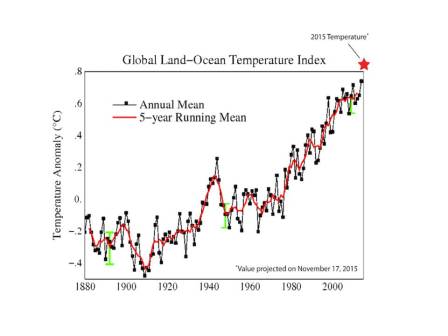
The favorite myth of the Deniers of man-caused global warming in recent years has been their claim that global warming has not occurred during the last decade.  This period of relatively little temperature change has been called the “hiatus” and used by the Deniers to discredit the scientific communities of the world who are convinced that global warming is occurring due to the activities of mankind and will continue into the future if business-as-usual energy policies persist.

Meanwhile, the scientific community has shown that we have not, in fact, reached a point of temperature stability yet and that future temperatures will continue to climb. They have pointed out that what might appear to be a pause in temperature increase over the last decade is largely due to natural variations that have momentarily offset some the greenhouse gas warming caused by humans.  In addition, the scientists have warned that natural variations go both ways, up and down, and when they turn towards warming, the Earth will experience an unprecedented jump in global surface temperatures.

Well folks, guess what?  With only two months left in the year 2015, we can now predict with a good level of certainty what the temperature will be for 2015.  That prediction is shown as the last point on the graph shown below.

Need I say more?  Don’t think so other than to ask why the Deniers would have used these data to suggest that global warming had stopped in the year 2000.  Now that we are about to enter a new decadal era in which distinctly increased temperatures are expected to regularly set new annual records, one wonders what the Deniers will come up with next. Since I am sure that the snake-oil salesmen of the fossil fuel corporations are well aware of H.L. Menden’s encouragement to their ilk – “no one ever went broke by underestimating the intelligence of the American public” – I fear that they still might not change – in spite of the clarity of the facts.  So Senator Inhofe, Rush Limbaugh, and most of the Republican candidates for President, is there still something about the graph shown above that you don’t understand?  If not, why not finally get on board and become part of the solution.

Yes, indeed, that statement is true.  About 50 million years ago, for example, CO2 levels were about 1,500 ppm, almost four times higher than today, and as a result our oceans were much more acidic.

Since the Deniers of AGW repeat these statements often, it is important to know what the appropriate responses are. That response is relatively easy to provide if the Denier is referring to the effect of CO2 on our climate.  One simply has to point out that the world was very much warmer 50 million years ago precisely because of that higher level of CO2 in the atmosphere. It was so warm, in fact, that the world had no ice on it and sea levels were about 70 meters higher than today – thereby flooding a large fraction of today’s land masses on which billions of people live.

But there is another closely related claim that the Deniers of CO2’s detrimental effects make today that is more difficult to respond to.  Environmentalists now correctly claim that our increased atmospheric CO2 levels are making our oceans more acidic and that this will be very detrimental to critters in the sea that have shells made of calcium carbonate (CaCO3).  This is because CaCO3 is more soluble in water of higher acidity and this will put greater stress on critters with CaCO3 shells.  If this claim is correct (which it is) how then does one respond to the Denier’s retort that “if CO2 levels were four times higher 50 million years ago and the oceans were therefore much more acidic than today, why then were ocean critters, including those with CaCO3 shells, so prolific back then (as we also know from the fossil record)? That question is a tougher one to answer and is more likely to produce a “gotcha” moment if the issue is not well understood.  Therefore, the rest of this post will provide a response to that potential show-stopper that will hopefully be useful whenever the question comes up.

First, let’s consider the three equilibrium reactions shown below involving atmospheric CO2 and the solid CaCO3(s) of critter shells.  Note that the term “equilibrium reactions” means that the reactions shown go both ways, forward and backward.  The rates of these three reactions are relatively fast in both directions resulting in an equilibrium state that responds quickly to any changes in the system – such as the addition or removal of any of the species shown.

CO2 (atm)   +  H2O   =   H2CO3                      (1)

H2CO3 +  CO3 =   =   2 HCO3                         (2)

Ca++  + CO3=   =   CaCO3(s)                          (3)

In accordance with Reaction 1, as the level of CO2 rises in our atmosphere, more of it will be dissolved into the oceans – where it is instantly changed to H2CO3 by the addition of one water molecule to that CO2 molecule.  This makes the oceans more acidic because H2CO3 is a weak acid.

The ocean naturally contains H2CO3 and the two other acid-base forms of this species shown in Reaction 2.  The most abundant of these is the bicarbonate ion HCO3–  which is an acid-base neutral species. Another is the weak base, carbonate ion CO3=.  Upon being added to the ocean, H2CO3 will react rapidly with the CO3=  ion to form more HCO3–  at the expense of CO3=  as shown by Reaction 2.

Reaction 3 shows how solid CaCO3 is formed by the combination of calcium ions, Ca++, and CO3= ions.  As the concentration of  CO3=  is reduced by Reaction 2, the formation and retention of a calcium carbonate shell (CaCO3) by Reaction 3 will be made less favorable and, therefore, will stress any critter that requires such a shell.  Thus, the combination of Reactions 1 – 3 supports the notion that shell-bearing critters should not have existed in the very acidic oceans of 50 million years ago, as claimed by the Deniers.

But wait! There is more and the Deniers are also wrong on this one.  Events that occur over a relatively short period of time (such as over a several years or decades) can differ greatly from those occurring over a relatively long period of time (such as a few millennia) because in the natural world other much slower reactions have determined the final equilibrium states.

The most important of these slow processes is called CO2 “weathering” which occurs in raindrops as they fall from the sky and land on rocky surfaces that contain various inorganic calcium and silicon compounds including solid CaCO3 (s).   In a raindrop, Reaction 4 is the same process as shown by Reaction 1 above except that in this case, CO2 is being absorbed into a rain drop consisting of pure water instead of into the pH-buffered ocean. Therefore, the H2CO3 molecules thereby formed are not substantially changed by a Reaction 2.

CO2 (atm)   +  H2O   =   H2CO3                                           (4)

H2CO3   +   CaCO3 (s)    =   Ca++  +  2HCO3     (very slow)           (5)

Then, by the very slow process shown as Reaction 5, H2CO3 in the rain water reacts with inorganic components of the rock (such as CaCO3) to form Ca++ and bicarbonate ions which are eventually carried to the oceans.  Given enough time, this process adds enough calcium ions to facilitate the formation of CaCO3 by Reaction 3 previously shown above.  In addition, the amount of CO3=  is then also increased somewhat by the reverse of Reaction 2 – also facilitating the formation of CaCO3(s).  It should also be noted that Reaction 5 would have been much faster in the warmer world of 50 million years ago when much more water vapor was in the atmosphere resulting in much more rainfall than today.

All of this taken together shows that, yes, increased acidification of the oceans will stress CaCO3-shelled critters in the sea – but only if a change in atmospheric CO2 levels occurs relatively rapidly – as it now is.  On the other hand if those changes occur over a long period of time – such as over several millennia or millions of years – the oceans will still get more acidic but the formation of CaCO3 shells will then be facilitated by the slow weathering process shown by Reactions 4 and 5.  These two slow reactions will then become the dominant means of providing both Ca++ and CO3= ions to the sea, instead of the dissolution of CaCO3 (s), thereby providing sea critters with an efficient means of making their shells.

Hopefully, this post helps explain why sea critters prospered in geologically ancient times when the Earth did not have forces acting on it that changed background CO2  levels so quickly as mankind is presently doing.  Therefore, one simple response to the second question of the Denier posed above is “we are doing some things to both our atmosphere and our oceans much too rapidly as to allow Mother Nature’s natural corrective processes to keep up”.  Therefore, the chemical system determining CaCO3 solubility in our oceans is momentarily out of balance and our shell-bearing critters are paying the price.


Posted by: ericgrimsrud | November 5, 2015

What if Exxon had told the truth?

About 25 years ago, Exxon made a conscious decision to stop providing the public their scientific opinion concerning the likely effects of carbon dioxide emissions on future global temperatures. Up to that point in time, Exxon scientists had been leaders in the field of climate change research and had provided reports to both their Board of Directors and to the public at large. That research had caused Exxon scientists to suspect that the effect of our increasing atmospheric CO2 levels on future global temperatures might require corrective action.  In fact, within their own company, Exxon did take action concerning their operations in Arctic regions where climate change was expected have particularly pronounced effects.

Then in 1990, Exxon’s CEO and Board of Directors became even more concerned about the negative effect this new scientific information might have on their own business.  For this reason, they decided to change their strategy concerning climate change research. They stopped doing it themselves and, instead, decided to put their money behind a public campaign designed to spread doubt on the similar scientific conclusions being drawn by all other scientists on this topic. They did this via their own advertisements and their financial support of organizations and individuals who shared that goal.

Therefore, since 1990 Exxon has been telling the general public and our elected officials that we don’t know enough yet as to merit corrective actions.  In addition, they have urged us to allow the fossil fuel industries to continue to “drill, drill, drill” in a quest for finding more gas and oil reserves.

For their intentional misrepresentations of science of climate change, I believe that Exxon (now ExxonMobil) should be prosecuted.  Surely, our criminal code includes statutes that aim to prevent harm knowingly done to the public merely for a corporation’s financial gain.  My previous post on this web site focused on that point and I will not repeat that argument here.  Instead, I will refer you to another article bearing a similar title  – “Imagine if Exxon had told the truth” by Bill McKibben (see it at http://www.theguardian.com/environment/2015/oct/28/imagine-if-exxon-had-told-the-truth-on-climate-change). In his article you will see how we could have avoided many of the tragic setbacks that will result from our last 25 years of ignorance and conflict on this subject – which could have been avoided if the most lucrative corporation in the history of our country had simply told the truth concerning its own discoveries in the area of climate change 25 years ago and had not, instead, used its considerable reputation, resources, and influence to undermine the same opinions being developed by other scientists in university and government labs thoughout those 25 years since 1990.  A few thoughts of my own on this question will follow.

If Exxon had continued to tell the truth 25 years ago, our atmosphere today would contain a significantly lower level of CO2 – now passing the 400 ppm mark which is 40% greater than is was at the onset of the Industrial age.  Back in 1990, the background level of CO2 was 353.  During the last 25 years annual emission rates have continuously increased throughout the world thereby causing that 50 ppm additional increase in that most recent 25-year period.  In addition, annual emission rates are still increasing today – they have not yet even leveled off.  Surely with help – instead of the hindrance – that might have been provided by Exxon over the last 25 years, we would have by now stabilized and even reduced CO2 emissions by today.  Instead, we simply watch those emissions continue to rise today and blame it on other countries, such a China and India, who understandably had looked for leadership from the developed countries that are largely responsible for creating the elevated CO2 levels we have today. Clearly, the general public of the USA has also been remiss in going along with the comforting, but misleading advice provided by ExxonMobil and the likes of Rush Limbaugh and not that provided by all of our scientific academies.

The tragedy of all of this was clearly laid out in the 5th point explained under the “Science Basics” tab at the top of this web site.  That point was explained with use of the figure shown below.

Mens Breakfast 2015

As was more thoroughly explained in “Science Basics”,  in order to prevent global surface temperatures from increasing by more than 2 degrees centigrade, future emission rates will have to be reduced as shown to the right side of “Today”.   How rapidly those emissions must be reduced strongly depends on the date of our “peak emission” rate.  If that date were today, our future reductions would have been doable as shown by the blue curve.  We are not on that course, however.  Emission rates continue to increase every year.  Thus we are on a course described either by the green curve or perhaps the red curve for which the year of when our global emissions are leveled and thereafter decreased.  In both of these cases, future reductions in emissions will have to be so extreme as to render them exceedingly difficult or even impossible.

If Exxon had told the truth 25 years ago, it is very likely that we would have managed to stay on a course in which the peak emissions rate was achieve either by Today or sooner.  In that case future emissions reductions throughout the 21st Century would have been doable as shown by the blue curve. Thus we find ourselves today facing a task that is either exceedingly difficult or not even possible – depending on when exactly our peak year is reached.  All of this because Exxon decided to place a higher priority on its short-term financial gains over the last 25 years and, even worse, did their very best to prevent any efforts to reduce those annual emissions.  From the recent Citizen United ruling of our Supreme Court, we learned that Corporations deserve the rights of individual citizens.  I hope that also means that they should be held responsible for criminal behavior intentionally perpetrated on their fellow citizens.  If the words we use to formulate the laws of our country have any meaning, ExxonMobil should be forceful prosecuted for intentionally doing great harm to our environment and the public. I can not think of a greater, more profound and more lasting disservice ever perpetrated on human beings.

Posted by: ericgrimsrud | October 25, 2015

Something we should do right now – Prosecute!

The second report of Exxon’s misrepresentation of their own climate change research during the last 25 years is now out. It recently ran in the Los Angeles Times and can be seen at http://graphics.latimes.com/exxon-research/.  (I previously discussed the first report in a September 2015 post. You should also read that report if you missed it.)

As you read these reports, ask yourself: if they are accurate, does Exxon’s behavior not constitute a crime against the citizens of our country and more generally one against humanity, in general?  For example, how could Exxon’s actions be considered less harmful to public wellbeing than the criminal behavior of the tobacco industry in its misrepresentation of the health hazards of tobacco products?  Shouldn’t we be prosecuting Exxon today for its intentional misrepresentations of fossil fuel use during the last 25 years – during which Exxon was very well aware of the likely detrimental effects of the elevated carbon dioxide levels present in our atmosphere?

I, like Bernie Sanders, think that Exxon should be prosecuted to the full extent of the law. Why not?  Is Exxon now one of those “too big to fail” corporations that must be excluded from punishments for its criminal behavior – perpetrated solely for its own financial interests?  Is the fact that an appropriate fine for their past behavior might bankrupt Exxon and lead to great financial losses for its numerous investors constitute a reason for not prosecuting this crime?  Are our laws and the enforcement of them determined merely by envisioned financial outcomes of such prosecutions?  If, on the other hand, words have meaning and the laws created by those words have substance, shouldn’t we proceed with the legal case against Exxon on the basis of the information being revealed in these emerging reports? If, due to their long-time usage, fossil fuels are now as American as apple pie, wouldn’t we still prosecute even a vendor of apple pies if that vendor knew their product contained a substance that was likely to be harmful to humans and then focused their promotional efforts on hiding that knowledge from the public? For recommending that we do the right thing in this instance, is Bernie Sanders going to be dismissed as a “socialist” because he dares to hold one of our nation’s largest and wealthiest industries accountable for its actions? Are we going to continue with the suicidal assumption that what’s good for our fossil fuel industries is also good for our economy?

Yes, this really is a test case for addressing that ever-present question: is the USA today an oligarchy run in accordance with the preferences of its most wealthy or is it a constitutional democracy run in accordance with its Constitution and laws. For those of you who believe the latter, it would seem appropriate to encourage the legal actions recommended here. For those of you who believe the former (and I am sure there are lots of you out there), you might at least consider divesting yourselves from the fossil fuel industries before the very thin ice on which their existence now depends melts away.

To Abe Lincoln’s famous quote, “you can fool some of the people all of the time and perhaps all of the people some of the time, but you cannot fool all of the people all of the time”, I would add, “and you can never fool Mother Nature at any time”. And, it turns out, our fields of Science have historically provided our most successful means of predicting what Mother Nature does.

The unforgivable crime committed by Exxon was to deliberately hide and obscure that scientific information from the public view over the last 25 years – just so it could continue to rake in billions per year for as long as possible. Considering the likely outcomes of their successful charade, Exxon’s actions are now sure to set in motion a literal holocaust of physical conditions for future generations trying to develop meaningful lives throughout our entire planet.

In order to conduct the trial being suggested here – the historical importance of which would be sure to rank with the trials held in Nuremberg starting in 1945 – perhaps we should consider using lawyers from other countries that appear to be more aware than ours of science, in general, and climate science, in particular. If so, it might be particularly appropriate to have German lawyers return the favor American lawyers once provided them in the prosecution of German citizens for various alleged crimes against humanity. Germany today seems to have a far better sense of its obligation to preserve the global environment than does the USA (see my previous June 2015 post concerning this point). In addition, due to the indebtedness most American politicians have to the fossil fuel industries for financial assistance during their elections, it might be more appropriate to hold those trials somewhere other than the USA.

Posted by: ericgrimsrud | October 16, 2015

Democratic Candidates easily Trump the Republicans

After watching the Republican presidential candidates ignore the greatest problem that faces mankind today, I was very pleased to see that climate change was clearly recognized and appropriately discussed in the Democratic debate last Tuesday.  Of the five presidential candidates included, only the remarks of one, Jim Web, were forgettable – he merely stated the obvious fact that addressing this problem would be of no use if other countries of the world weren’t involved.  All of the other candidates seemed to recognize the absolute necessity and urgency of the problem and had credible suggestions for strong action.  In addition, I was very pleased to see in this debate the substantial amount of time and questions devoted to this topic. This point, alone, constitutes a landmark change in American politics.  Finally, it appears that addressing climate change has become one of the highest priorities for at least one of our political parties.

As I had related in a previous post on this website (July 28, 2015) Bernie Sanders is the strongest and clearest Democratic candidate on this issue in that he strongly advocates a stiff and badly needed carbon tax on fossil fuel use. On this issue, Hillary Clinton is not as strong as Bernie, but is gradually getting there.  She has now at least come out against the Keystone XL Pipeline and, I believe, is smart and aware enough to learn what has to be done. Her great advantage is that she acts and looks “presidential” and is eminently qualified and electable.  My hope is that if and when she does win, that Bernie Sanders also rises to a place of prominence in that new Democratic administration – the country would be very well served by both of them.

And if, on the other hand, a Democrat does not win the Presidency next year, I can’t bear to think about what would then (not) happen. One of the few things that the Republican candidates agreed on in their last debate was that “nothing can be done” about global warming! The threat posed by our elevated CO2 levels has now risen to such a high level of extreme urgency that it has momentarily turned me into a “single issue guy” – just as Winston Churchill was similarly affected in 1940 when Nazi Germany advanced to his doorstep. At that time Churchill offered the British people “blood, toil, sweat, and tears” in the ensuing fight and declared that “without victory, there will be no survival”. Yes, whether we all realize it or not, we are presently engaged in an analogous war of survival and this one is with the barons of the fossil fuel industries. Their lucrative, but suicidal means of producing energy makes them the new “evil empire” that simply must be taken down if present forms of civilization are to survive. And in doing so, it would help a great deal if our dysfunctional Republican Party would simply disappear into their self-imposed respite from public service. If one can’t lead or follow, my suggestion to them is that they simply get out of the way and remember that accepting those 30 pieces of silver being offered by the fossil fuel barons would not nearly cover the far greater costs they would be passing on to their grandchildren.

Posted by: ericgrimsrud | October 8, 2015

We need either better people or a stiff carbon tax

Now that Pope Francis has gone home, we have to deal with our environmental problems with the cast of characters that live full time in our country – and that will be exceedingly difficult, as I will make clear in this post.

According to the most comprehensive view I have ever heard on the subject of climate change (see this 45 minute lecture at  http://vimeo.com/62871951), the only means of significantly reducing CO2 emissions in the current decade would be via changes in the lifestyles of the “most wealthy” among us. They are the ones that emit the most CO2 and the only ones that have the option of making changes.  And who are the most wealthy ones?  Again, according to the scientific analysis cited above, that group is very large and includes almost everyone, for example, who travels via airlines once or more per year and has an annual income of roughly $50K or more.  That includes most of the people I know, including myself.

In discussing the problem of man-caused climate change with almost everyone I encounter, that conclusion is invariably reinforced.   Those discussions quickly come to a point where it is clear that my wealthy friends and I are, indeed, ruining our planet and are not going to voluntarily use the opportunity we presently have to save it from further degradation by CO2-induced warming.  There is a great deal of “talking the talk”, of course, but very little “walking the walk”.

When we reach this point in our conversations, further discussion almost always comes to a close with the following thoughts,  I suspect,  lodged in my friend’s head:   “What’s this?  Change my lifestyle?  I have worked hard during my lifetime.  Don’t we owe these things to ourselves?  Surely, you are joking, Eric.  You don’t seem to know how things are done today?   You are crazy.  Only a few whackos will change their lifestyles to that extent for something that has not actually happened yet. “  And note here that I am not referring to conversations with Deniers of climate change.  I am talking about discussions with people who consider themselves to be conscientious concerning environmental issues.

Furthermore,  I have seen almost no improvements in that discussion over the last 10 years  – the period over which the “wealthy” among us have clearly been called out in scientific reports such as that cited at the top of this post.  The prevailing opinion that we owe a high life to ourselves now seems to be one of the modern laws of human behavior even though it is sure to threaten our very existence.  Humans, as it is said lemmings do, are charging toward the cliffs and are being led by the most prosperous among them.

How this ubiquitous view of the wealthy can ever be overcome, I am not sure.   Maybe this change is impossible because people simply aren’t that good.  Thus, one means of encouraging change might be to heap well-deserved ridicule on ourselves and especially on my own generation of Americans. That brings to mind a joke I heard some time ago when George Bush was running for the Presidency. The joke went like this: “George was born on 3rd base and while growing up, he increasingly came to believe he had hit a triple!”.  I think the brunt of this joke could easily be changed to my generation of Americans.  We were born in a “Goldilocks” era of American history in which everything was “just right” for its youngsters. The Great Depression and the Second World War were behind us and ahead lay an unprecedented period of prosperity and material abundance.  Red carpets of professional opportunities where laid out for all of us in all directions.  But now, as my generation nears or is in retirement, it tends to think that we all “hit triples” during our working years and deserve a high life for the rest of our days.  And if the science tells us that a high life will make life increasingly difficult for our grandchildren – well, we just choose to not think too much about that. After all, maybe “something will come up” or maybe our scientists have overlooked something. That is possible, right? (even though it is exceedingly unlikely after several decades of intense study).  In any case, our plans are to stuff as much of that high life into our remaining years as we can.  We deserve it, right?  So Eric, can’t we please change the subject – as even my close relatives have told me numerous times.

In order for any society to address great problems, some level of leadership among the best educated and wealthiest would be nice to have.  However, we don’t have that in our country today.  In fact, our most wealthy and best educated are leading the degradation of our planet and are not using their considerable influence to change things.  I suspect that ours will be the last generation to pay more attention to the Dow Jones Industrial Average than to the Keeling Curve (and if you don’t happen to know by now what the latter term refers to, you should hit the “Science Basics” tab at the top of this website and read “Point 2”).

There is only one way I can think of by which the “behavior” of people can be significantly improved and that is by the installation of a stiff and steadily increasing, revenue-neutral Carbon Tax. With this additional fee assigned to fossil fuel industries for their use of our communal atmosphere as a CO2 waste dump, needed changes would be expected to follow due simply to traditional market forces.  Again, if you don’t now know what I am now talking about, please have a look at my first post of November 2014 on this blog in which this carbon fee plan was thoroughly explained.  Seems to me that the wealthy should, at the very least, be using all of their influence to get this energy plan in place as well as divesting themselves and the organizations they belong to from the fossil fuel industries.

« Newer Posts - Older Posts »

Categories