Oh goody, goodly – we finally know how our planet is going to be saved from future degradation by global warming. It increasingly appears (see my June 2016 post entitled Post Paris Accord assessment) that our global leaders, such as those who attended the Paris conference in December 2015, think this will happen via a technology known as BECCS (Bioenergy with Carbon Capture and Sequestration). So, what is BECCS? With the aid of the following figure, it can be easily explained:

The basic idea is that we feed our power plants with biomass (wood, grass, plants, etc) instead of fossil fuels (coal, oil or natural gas) and install carbon sequestration apparatus to the smoke stacks of those power plants by which a large portion of the combustion product, CO2, is captured. That near-liquid form of CO2 is then transported via pipelines to voids deep in the Earth where the CO2 can be deposited and stored for many thousands or even millions of years. In theory, this technology offers both power generation and a means of removing carbon from the biosphere.
The next question, of course, is will it work? Yes, it is true that each of the individual steps shown in the figure above have been demonstrated and shown to work on vastly smaller scales. They are presently being studied and used throughout the world. The remaining question, however, is whether or not BECCS can be scaled up enormously to a magnitude that could actually result in significant decreases in atmospheric CO2 levels over the limited period of time we have left for preventing the worst outcomes of greenhouse gas warming.
With such a massive BECCS system, a point of concern is that huge sections of arable fertile land and associated water supplies would have to be dedicated to making the amount of biomass required. It is estimated that the equivalent of one to three “India’s” would be required and these chosen biomass farms would preferably be located near both the associated power plants and the burial sites of the captured CO2 in order to minimize transportation costs and additional greenhouse gas emissions.
Upon learning just this bit about BECCS, you are perhaps already somewhat skeptical of both the technical and financial feasibility of this technology and I would expect you to be. Yet, if you have followed the debates and conferences concerning climate change being held throughout the world – such as the recent one in Paris – one definitely gets the feeling that we will be betting our futures on BECCS implementation by the middle of this century – when atmospheric CO2 levels will have soared well above the present already dangerous level of 401 ppm.
So the question then arrises, why are we headed in that direction – rather than trying ever harder to simply cut in our continuing emissions of CO2? After all, we know how to do the former and know that it would work, but do not yet know very much about the feasibility of the latter. Answers to this question seem to include the following:
- The Business as Usual (BaU) forces of the world and the USA especially like the BECCS plan because it allows continued use of fossil fuels in the up-coming decades. According to this plan, the additional CO2 that will be thereby deposited into the biosphere during the next few decades will simply be removed by bigger and better BECCS systems later, right? So easy to say while so difficult to do.
- And let’s face it, almost all of us want to do something for those “future generations” that we are always reminded of in climate change debates. Even though the BECCS plan does little of substance now, it does provide “a plan” and some hope for those future generations. That is, we will at least be offering our grandchildren something – even though they, and not us, will have to pay for it. And who knows, maybe “something will come up” by midcentury, right? Such as great improvements in carbon capture technologies or biomass production. Of course, yet another description of what I am saying here is that we will be continuing to “kick that can down the road” – an activity our generation has become very good at.
- Also you should note that the closely related technique of CCS (Carbon Capture and Sequestration) is sure to be promoted as an intermediate stepping stone to BECCS in that it seeks the removal of the CO2 emitted by fossil-fuel-fired power plants (often referred to as “clean coal”). While this technique does not result in a net reduction of carbon in the biosphere, it seeks, at least, to be carbon neutral. Thus, CCS is the big hope for the continued use of fossil-fuel-fired power plants including those that still rely of our abundant supplies of coal. Never mind the facts that other pollutants, such as mercury and cadmium, are also emitted by coal-fired plants and that large quantities of the powerful greenhouse gas, methane, leak into the atmosphere in the mining and transport of natural gas to power plants. It should also be noted that CCS has not yet been shown to be technically or financially viable on the large scale its proponents like to envision.
So here we are in the new post-Paris Accord era – proceeding with BaU modes of operation and lifestyles – thinking that future generations will be able to develop techniques such as BECCS in order to remove the excess CO2 that first began to show up in about 1850 and is still being added today at an unprecedented annual rate of about 2 ppm. By 2050, the biosphere can be expected to contain at least 50% more carbon than it ever has had naturally over the last 3 million years. It now contains 40% extra carbon. The last time our atmosphere had 450 ppm CO2 in it, the Earth was almost a “water world” with very little ice anywhere on it. Therefore by BECCS, the plan is to remove over 500 billion tons of carbon (that is, 2,000 billion tons of CO2) from our biosphere and permanently park that carbon dioxide deep in the geosphere. That’s an awful lot of carbon to be removed – approximately equal to all of the carbon that has been burned, to date, in the entire Industrial Age. And if this endeavor is to be effective, it would have to be done relatively promptly, that is, during the remainder of this century. Whether this “gift” of the BECCS plan to our grandchildren turns out to be anything of value to them or is presently being favored simply to soothe the consciences of those of us who will be allowed to continue our extraordinarily pleasant fossil-fuel- driven lifestyles remains to be seen.
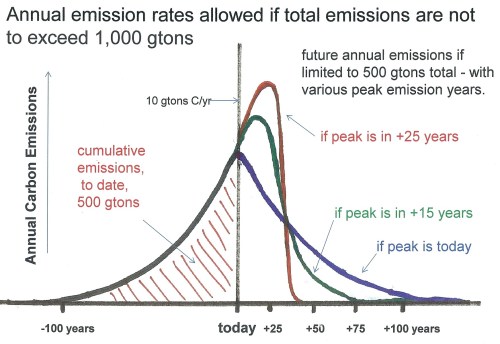
 In addressing the global warming problem, we must recognize that the countries of the world will have differing abilities of making necessary changes. The more developed and wealthy countries of the world will be in a much better position to install alternate means of energy production, such as wind mills, solar panels, and nuclear power plants, than the less developed and poorer countries. Therefore, in Figure 2 I have divided the total emissions shown in Figure 1 into two parts – one for the developed and one for the developing countries.
 ericgrimsrud