Posted by: ericgrimsrud | December 9, 2014

The “Not Settled” aspects of climate change science

Only in one sense is the science of global warming “not settled”. That sense concerns the additional details that are being added to the concept of anthropogenic global warming by ongoing research each year – while the basic notion of man-caused warming has not been seriously challenged in the scientific literature of the last decade. If one reads the peer-reviewed literature, examples of these new details abound. Since few within the general public read that literature, I will take this opportunity to provide just three examples of it here – gathered from research articles published in the last month. For each of these, I will include the abstract of the paper along with a brief summary of its relevance. .

One of these three papers focused on the effect of very recent volcanic activity on surface temperatures (see it at: http://www.nature.com/ngeo/journal/v7/n3/full/ngeo2098.html).

Volcanic contribution to decadal changes in tropospheric temperature
by Benjamin D. Santer et al.,
Geophysical Research Letters
Abstract
Despite continued growth in atmospheric levels of greenhouse gases, global mean surface and tropospheric temperatures have shown slower warming since 1998 than previous. Possible explanations for the slow-down include internal climate variability7, external cooling influences and observational errors. Several recent modeling studies have examined the contribution of early twenty-first-century volcanic eruptions to the muted surface warming. Here we present a detailed analysis of the impact of recent volcanic forcing on tropospheric temperature, based on observations as well as climate model simulations. We identify statistically significant correlations between observations of stratospheric aerosol optical depth and satellite-based estimates of both tropospheric temperature and short-wave fluxes at the top of the atmosphere. We show that climate model simulations without the effects of early twenty-first-century volcanic eruptions overestimate the tropospheric warming observed since 1998.

Summary by EPG: A portion of the recent slow-down in increased surface temperatures is likely due to the reflection of incoming solar radiation by the sulfate particles produced by the recent volcanic activity. (Note that individual volcanoes do not cause significant warming – they emit relatively little CO2. However, they do cause short-term cooling due to their effect on the Earth’s albedo, that is, the reflection of incoming light. This SO2-induced cooling by volcanoes only lasts a few years and is related to the size of the volcano and its ability to punch SO2 very high into the stratosphere where the removal of sulfate particulates is much slower than in the lower troposphere.)

A second recent paper (can be seen at http://onlinelibrary.wiley.com/doi/10.1002/2014GL062433/abstract) provides sme interesting insight concerning the drought in the American Southwest.

How unusual is the 2012-2014 California drought?†
by Daniel Griffi* and Kevin J Anchukaiti
Geophysical Research Letters

Abstract
For the past three years (2012-2014), California has experienced the most severe drought conditions in its last century. But how unusual is this? Here we use two paleoclimate reconstructions of drought and precipitation for Central and Southern California to place this current event in the context of the last millennium. We demonstrate that while 3-year periods of persistent below-average soil moisture are not uncommon, the current event is the most severe drought in the last 1200 years, with single year (2014) and accumulated moisture deficits worse than any previous continuous span of dry years. Tree-ring chronologies extended through the 2014 growing season reveal that precipitation during the drought has been anomalously low but not outside the range of natural variability. The current California drought is exceptionally severe in the context of at least the last millennium and is driven by reduced though not unprecedented precipitation and record high temperatures.

Summary by EPG: It appears that the drought presently being experienced in the American Southwest is unique – probably the most severe in the last millenia.

The third paper (see it at http://iopscience.iop.org/1748-9326/9/12/124002/article) examined the time delay between the emission of carbon dioxide into the atmosphere and its affect on surface temperatures.

Maximum warming occurs about one decade after a carbon dioxide emission

by Katharine L Ricke and Ken Caldeira
Environmental Research Letters

Abstract
It is known that carbon dioxide emissions cause the Earth to warm, but no previous study has focused on examining how long it takes to reach maximum warming following a particular CO2 emission. Using conjoined results of carbon-cycle and physical-climate model intercomparison projects (Taylor et al 2012, Joos et al 2013), we find the median time between an emission and maximum warming is 10.1 years, with a 90% probability range of 6.6–30.7 years. We evaluate uncertainties in timing and amount of warming, partitioning them into three contributing factors: carbon cycle, climate sensitivity and ocean thermal inertia. If uncertainty in any one factor is reduced to zero without reducing uncertainty in the other factors, the majority of overall uncertainty remains. Thus, narrowing uncertainty in century-scale warming depends on narrowing uncertainty in all contributing factors. Our results indicate that benefit from avoided climate damage from avoided CO2 emissions will be manifested within the lifetimes of people who acted to avoid that emission. While such avoidance could be expected to benefit future generations, there is potential for emissions avoidance to provide substantial benefit to current generations.

Summary by EPG: This paper suggests that CO2’s maximum effect on future temperatures occurs in only about 10 years after emission, rather than several decades as has previously been estimated. If substantiated, this new insight puts even greater emphasis on the need to cut emissions of the greenhouse gas, carbon dioxide, as quickly as possible.

Yes, indeed, the science of climate change is “not settled”, as the deniers of man-caused warming like to say. However, it is now also clear that the only scientific aspects of the issue that are “not settled” concern the endless details of the multiple factors involved. In addition, as more of these details are revealed the devils often residing within them are also exposed. From the three recent studies I have described here, we saw examples of this including: more evidence that the recent leveling of surface temperatures rise does not suggest that warming by CO2 is over; the present drought in Southern California is very likely not just part of a natural cycle; and future warming due to our emissions of CO2 will occur sooner than previously thought. I wonder how many additional details and embedded devils will have to be revealed before mankind considers the issue to be sufficiently “settled” as to merit forceful action.
Posted by: ericgrimsrud | December 4, 2014

Why we don’t have the NFPTFCPFM energy plan yet.

In my previous post, I described what seems to be an obvious and entirely fair energy plan.  While I have coined the lengthy acronym for it shown in the title above, a more common name given to it is the Carbon Fee and 100% Dividend plan.  So the question follows – why hasn’t this plan been adopted yet?  While I don’t know the complete answer to that question,  I have provided below a set of reasons that I suspect explains some of the resistance to it.

First, it is true that our atmosphere is being used as a waste dump for a substance that will stay there essentially forever and will change our climate so much as to threaten human civilization possibly by the end of this century. But it is also true that that substance, called carbon dioxide, is invisible and this fact apparently makes a great difference. Why worry about something you can’t see and is not directly toxic to human beings?  It apparently takes an atmospheric scientist to understand why our excess levels of CO2 presents an enormous problem and only a tiny fraction of our population are atmospheric scientists.

Next, try to imagine the total financial investments of the world that are counting on the continued use of fossil fuels. These countries include not only several in the Middle East and Africa, but several of our historic allies of the Western World, including Canada and Norway, and, of course, the USA itself.  If we appropriately acknowledge the problem that is being caused by fossil fuel use, we would then have to leave most of those fossil fuels in the ground and that would constitute an enormous loss of wealth worldwide. Just within the USA that loss would be the greatest since slaveholders lost the ownership of their slaves in 1865 due to the passage of the 13th amendment. Thus, it is too easy for those invested in fossil fuels to say: so why don’t we just wait a bit before taking action – maybe “something will come up”. Sure that is questionable, reckless logic, but we’re talking about a lot of money, right?

And then there is the fact that the public is easily confused on scientific issues.  They don’t read the peer-reviewed scientific literature where the issue of AGW is no longer contested.  They only read non-peer-reviewed public literature and personal opinion columns and  in that “literature” one can find any point of view one wants to find.  And the public is very poor at distinguishing between bona fide research scientists  and phony “experts” who just talk  and look officious to the public. It does not help matters that the latter group spews an erroneous version of science that is much “happier” and more comforting than the former.

And then, let’s face it, most people have a priority list that is most heavily weighted on issues of immediate concern, such as paying their bills, taking care of their kids, getting them into good schools, getting their careers off to a good start, and accruing wealth for future needs.  Thus, an all too common attitude concerning climate change is to have none at all –  thinking  “someone will eventually take care of it” or “if things get really bad, science will save our way of life and that of our grandchildren”.  After all, isn’t that their job – solving problems and inventing new things?

And finally, I am reminded of the words of caution provided by President Dwight Eisenhower at the end of his two terms in 1961 – when he warned us about the growing power of what he called the “Military-Industrial Complex” of the USA.  As things have unfolded in the half century since Eisenhower’s departure, it is now clear that he might have extended his caution to include the “Military-Energy-Industrial Complex”.  As the quest for ever increasing amounts of energy required to drive our increasingly large and complex forms of civilization have risen to levels of prime importance, we have increasingly tended to address energy issues in a “Manhattan Project” style of the sort used to develop the first atomic weapons during WWI I.  This has resulted in a centralized approach to energy production in which the government plays the most important role at all levels.  Thus, many of us now seem to think that our government, only, is sufficiently large and powerful as to determine and provide our future sources of energy.

My brother, Dave, for example, who comments occasionally on this blog wants the government to “get on with it” right now and do whatever is required to build more nuclear power plants, such as the one in Red Wing, MN, that has been successfully providing his power for many years.  Dave does not seem to accept the idea – inherent in the Carbon Fee and 100% Dividend Plan – that our free market and the private sectors  would be capable of producing the energy we need (as well as saving back vast amounts of energy we waste due to inefficient lifestyles).  Thus, I end up trying to convince my brother of the benefits of a system that neither of us has seen yet – an energy plan propelled entirely by private investments and entrepreneurship played out on a field that is level for all contestants. In my opinion, Dave needs to consider once again the advice of Dwight Eisenhower.  There are many things we can do better without government direction and I think the production of energy of one of them.

Upon carefully considering each of the reasons described above for not accepting the Carbon Fee and !00% Dividend plan, the folly in each of them is clear. We simply must stop the relentless advance of CO2-induced Anthropogenic Global Warming or we will be leave our grandchildren wondering in just a few decades “what were we thinking?” back when  corrective action might have made a difference. The scientists clearly warned the public about AGW but the public ignored those warnings. Sure, carbon dioxide is invisible but so are lots of substances that scientists can “see” with modern instrumentation. Sure, leaving fossil fuels in the ground will constitute a huge financial loss to many, but to use it will cause far greater losses to everyone just a bit later. Sure, we are all busy with our other priorities, but human beings have been blessed with a brain that allows them to also see the future they are creating.  Sure, we have built up a Military- Energy – Industrial complex that effectively calls the shots in Washington DC, but it is time for us to follow the advice of Dwight Eisenhower concerning it and retake control over key issues of our lives that have been carelessly forfeited. We still do have a Representative Democracy, don’t we? Tell your political representatives to adopt the NFPTFCPFM [No Freebies, Pay the Full Cost, Pure Free Market] plan ASAP!  Only then will we see all aspects of climate change remediation fall into place.

Posted by: ericgrimsrud | November 17, 2014

The NFPTFCPFM Energy Plan

At the onset of this blog, back in June of 2012, one of my first posts was entitled “The Best Energy Policy” (ericgrimsrud.wordpress.com/2012/06/15/the-best-energy-policy/).  It is appropriate at this time to repeat and expand the theme of that post.  The energy policy it describes is the only way forward that makes sense – it is both “obvious” and “fair”.  For those very same reasons, however,  the fossil-fuel-related industries are terrified by the possibility that this plan might gain traction within the general public.  Therefore,  they do everything in their power prevent its exposure.  And the fact that this plan constitutes the most “market-based” of all plans, requiring the least government involvement of any really causes the Business as Usual (BaU) forces of America to soil their trousers.  Their only hope is to not let this plan reach first base.  OK, so what is this plan exactly?  A thorough explanation of it is the purpose of this post.

The Basic Plan Before assigning any name to it, let’s first start by explaining what it is.  The basic plan is to recognize and account for all appropriate costs associated with each method of energy production and then charge the users of that energy an amount that covers all of those costs.  In addition, the government should not be involved in deciding which means of energy production provides the best value to the public.  Let the free market decide who the winners and losers are.  Similarly, no government grants and tax breaks should be allowed – let the forces of a free and open market do the job. All of this should sound great to any red-blooded American businessman who has been raised on the notion the we have open and free markets, right?.

The problem with our existing BaU system, however, is that it needs to be significantly corrected so that it really is fair and provides a level playing field for all competitors.  In order to do that, ALL costs of energy production must be included – including the costs associated with WASTE DISPOSAL.  Again, you might be thinking:  “of course, the costs of waste disposal must be included – after all, we don’t allow the nuclear power industries to scatter their nuclear wastes over our fields, rivers and oceans, do we?”  No we certainly do not – so why do we let the fossil fuel industries use our atmosphere as a waste dump for the disposal of the CO2 produced by fossil fuel combustion?  That is the question that cannot be answered with a straight face. A correction for its corrupting effect on our free market system must be made. According to all credible scientific organizations of the world, our dramatically increasing atmospheric levels of CO2 are causing the greatest environmental problem and challenge ever faced by mankind.  It will be exceeding costly to address that problem and those future costs get much greater every year as we continue to use our atmosphere as a waste dump for CO2.  Shouldn’t these costs of waste disposal finally be included in the use of fossil fuels just as any level of common sense would suggest?

So how do we charge for CO2 waste disposal? That charge should be made in proportion to fossil fuel production at the point of extraction.  These extra costs would, of course, be passed on to the consumers of that fossil fuel.  Because of the stress that always accompanies change, the magnitude of those additional charges for future fossil fuel use should be relatively small at first with gradual and annual increases thereafter.  The amount of annual increases would then have to be linked to observations of CO2 levels in the background atmosphere and our goals with respect to reducing those levels.  This essential function is the only aspect of the plan that could not be left to the free market system.  The government’s traditional role of monitoring and controlling waste disposal would be required.

So what would happen in the next couple decades? As the total price of fossil fuel use gradually increased, the use of alternate sources of energy would become increasingly attractive. More entrepreneurs would enter this field,  public use of alternates would increase, and the total costs of the alternates would decrease. Therefore, a point would be reached – possibly within the first decade – when the costs of alternates would be lower than the costs of fossil fuels and the goal would be accomplished – we will have made the sought for transition to the alternate renewable sources of energy and would soon stop using fossil fuels.  Because of our past love affairs with fossil fuels, it is useful to remind ourselves that this is the desired and necessary outcome – we must stop all fossil fuel conversions to CO2.

What would we do with the money thereby collected from fossil fuel users? This is an excellent question that must be very carefully considered.  One must always be especially careful whenever the disbursement of money is being considered, right?   If we don’t disperse that money appropriately, all benefits of the plan will be lost. Some ideas for disbursement immediately come to mind – but most then fall apart upon further consideration.  One of these, for example, is why don’t we use these funds to offset existing taxes?  That is a terrible idea because it would leave the disbursement of this large sum in the hands of  lobbyists and legislators in Washington DC.  The inside track would go to those with the deepest pockets, as usual. Cynicism and corruption of the entire process would follow. Another idea is to use this large sum for the support of needed alternate methods of energy production or for badly needed improvements in our country’s infrastructure?  This is also a poor idea because, again, it would make Washington DC the spigot of funds to be directed towards the winners in battles played out by lobbyists and legislators.  Remember, we want the free market of ideas, entrepreneurship, and private investments to determine the winners in this competition.  While the government will have a essential role to play, that role should not be determine the outcomes. There are many other ideas, of course, but all but one are fatally flawed, in my opinion.  OK, so what do we do with the money?

The only good option I have been able to envision is to follow the principle of what is called the “shared commons”.   So what does that term mean? All of us breath and share the same atmosphere, right?, and depend on the critically important functions that thin blanket of gas serves in maintaining life-friendly conditions on our planet’s surface.  Therefore, our atmosphere is an example of a “shared common” of which we all lose a bit whenever it is used inappropriately by  others.  But again, what do we do with the money? The answer to that question is made clear by use of the following analogy.  Lets say a half dozen ranchers (I spent about 40 years in Montana, OK?) go together to buy a nice piece of grassland which they will share for grazing their cattle.  That piece of land not of infinite size, however, and would be ruined by over grazing if all of the ranchers were allowed unlimited grazing on it. And, of course, it would be unfair to let just one or two of the rancher to use it as they wished and not the others who have equal rights to it. The solution is obvious, is it not?  A good and fair solution would be to charge everyone a set fee for their use of the common field and then distribute those collected funds equally among the six ranchers at the end of each season.  In order to ensure that the field is not overused, the fee would continuously adjusted as to prevent overgrazing.  With this understanding, some of the ranchers might use the commons only to the extent where they would get their use payments back at the end of the year.  Others might chose to not use the common field at all and receive one-sixth of the pool of money collected at the end of the season.  This plan turns out to be fair to all – whatever  choice the individuals make.

OK, but how would this work for dispersing the pool of money collected for use of our atmospheric commons?  Answer: essentially in the same manner.  Every US citizen would by assigned a share for the joint ownership of the atmosphere.  Dependents and children might be assigned half  a share.  At the end of each year or quarter, the pool of money collected would be distributed equally to all share holders for them to do with it as they wish.  This disbursement  process could be handled easily by our existing Internal Revenue Service which already has all the information it requires for doing this automatically. With this system, a family of four, for example, might receive say $5,000 per year after the plan has been operative for say 5 years.  They could use that money as they wished – to cover the extra costs of the then more expensive fossil fuels, for example, if they wished.  Alternatively, they might want to look more closely to alternatives available to them – such as the purchase of higher mileage vehicles,  increased use of public transportation and simple changes in their lifestyle. Those chances might enable them to pocket a larger portion of their annual dividend.  At the same time, a citizen who is less concerned about the energy costs of his lifestyle would be free to use as much fossil fuel as he wishes and thereby contribute a larger amount to the atmospheric commons pool.  Eventually, however, even that individual would be likely to change the form of energy he uses as the alternates become better and much less costly. A very important aspect of this plan is that minimizes the roles of lobbyists and legislators in Washington DC.  The only decision of importance to be made in DC would be to set the magnitude of the fossil fuel change each year and that would have to be done in conjunction with an agency that understands the climate science involved.

Ya but, how about China and India?  Thanks for asking!  It turns out that another great advantage of this plan is that it would put a great deal of pressure on all other countries to adopt the same plan.  This would result simply by charging an additional import duty on all goods coming in from countries that do not have the same waste disposal plan for CO2 emissions that we have.   This, of course, would induce every country to collect such fees internally rather than have those funds collected in our country.  In this way, we would be using our greatest international force – our role as consumers of all things made elsewhere – to get other countries to follow our lead.

So finally, what is the name of this plan? While it doesn’t really matter what the plan is called, in this day and age of denigration by “name calling”, some care should be given to this detail.  While it has been called the “Carbon Fee and 100% Dividend Plan” (see more details about it at http://citizensclimatelobby.org/carbon-fee-and-dividend/), many who are petrified by its prospects prefer to call it a “Carbon Tax” because they know the word “tax” turns many against any idea so labeled.  Therefore, if it has to have a name, I would like to see it called something like the “No Freebies, Pay the Full Cost, Pure Free Market” plan (or the NFPTFCPFM plan, for “short”.  While I will acknowledge that my preference is a bit of a mouthful, whatever we end up calling it, I believe that my suggestion is the most descriptive. So lastly,  please get your legislative representatives behind the NFPTFCPFM plan! (PS. And please do not call this plan some sort of “commie plot”.  If you do, you might find yourself contributing to a batch of one of those Montana rancher’s Rocky Mountain oysers!).

Posted by: ericgrimsrud | November 15, 2014

Why the Keystone Pipeline is Madness

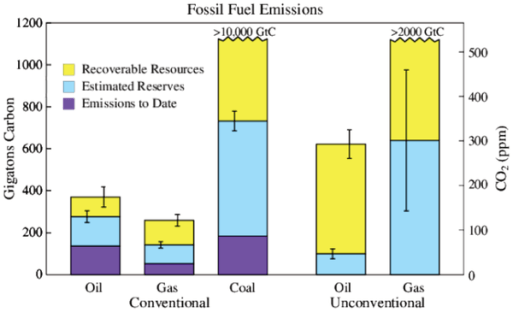
Inspection of recent paper by Hansen et al. reveals why the Keystone Pipeline project is sheer madness  (click here to see the full paper).   In this paper, the authors  provide the figure shown below which explains the challenge before us.

journal-pone-0081648-g002.png (600×365)

The amount of carbon (in units of Gigatons) that has been emitted in the past and might be emitted in the future from  the combustion of various types of fossil fuels is shown.  These sources include conventional oil, gas and coal and unconventional oil and gas.  The unconventional fossil fuels are those being developed by recently discovered means, such as the extraction of oil from the tar sands of Alberta, Canada, and the release of oil and gas following  the fracking of shale deposits. The various colors in each column indicate the amount already used to date (dark purple), the readily available remaining reserves (light blue) and the amount probably available if we continue to look for more (yellow).

Before considering each of the columns in the figure, let’s first consider the central point made clear in this paper and elsewhere that in order to allow the Earth to remain in its present state of stability, mankind should not burn more than about 500 Gt of carbon total over its entire industrial period – which began about 160 years ago and will continue into the foreseeable future.  With the emission of more than 500 Gt of carbon, the authors expect that the Earth’s climate will very probably leave its present stable state and enter into an unstable one that will subsequently drift into progressively warmer and distinctly untenable states in which human civilizations could no longer exist in their present forms.

Again, in order to avoid that hopeless condition, we must emit no more than about 500 GtC total between 1850 and some yet unknown future date when we do finally manage to terminate all carbon emissions.. So next,  how much carbon have we emitted to date?  The answer to that question is provided by the sum of the three dark purple bars in the figure above showing emissions to date of conventional oil, gas and coal.  These are 130, 60 and 180, respectively, for a total of 370 GtC.  So what does that leave us for allowable future use?  The answer is 130 GtC (500 – 370),  right?  With that number (130 GtC) in mind, let’s now consider the various fossil fuels we presently have for future use.

Let’s first consider the readily available conventional oil and gas deposits shown by the light blue bars in the first two columns.  These indicate that we have about 140 GtC of conventional oil and about 90 GtC of conventional gas readily available for our future use – for a total of 230 GtC.  Oh, Oh! – what’s this? . We are allowed to use only 130 GtC in the future and we already have much more than that in the forms of high quality and readily available oil and gas.  In fact, it looks like we will have to leave about 100 GtC of these prime supplies of gas and oil  in the ground.  So why is it that we are looking for more? Crazy yes, but it gets worse and then much worse.

Next, note the top yellow portions of the first two columns.  If we continue to try harder and drill more, we can probably double our future reserves  of conventional oil and gas.  But again, why are we trying to find more sources of conventional gas and oil when we already have more than we can use.

And still worse as we move on to the 3rd column concerning conventional coal.  Note that under its light blue bar, we have  an enormous amount, about 550 GtC, of unused and readily available coal – just waiting to be scooped up and transported to power plants throughout the world.  However, since coal  generates only about half as  much energy per CO2 molecule emitted as do gas and oil,  and because of coal’s additional environmental and human health issues (particulates and mercury), and because we have plenty of cleaner and more energy rich gas and oil, why would we want to continue to use coal for power generation?  All coal must be left in the ground and, no, carbon capture and storage has no chance of becoming financially viable.

And things continue to get even worse as we move on to the 4th and 5th columns where we see the new and so-called “wonderful new prospects” for future USA energy independence that is falsely promised by the developers of  unconventional sources of oil and gas. Again, the reaction to this so called “good news” of any mathematically literate person should be: “what the hell! – why are we bothering with these more expensive and dirtier sources of gas and oil when we already have far too much of the best forms of fossil fuels already available”.  In short, all unconventional gas and oil should be left in the ground.

So why, other than insanity, would we want to help another country transport relatively dirty and energy deficient tar sands oil to the international refineries on the Gulf Coast to then be transport to all markets of the world?

There is only one parameter mankind has under any control over in limiting the detrimental effects of global warming. That one factor is to limit our future emissions of CO2.  That is all we can do.  Therefore, we can afford to use only a portions of our existing reserves of gas and oil and nothing more. That’s it. So are we going to build the Keystone XL pipeline?  While we clearly should not, I also know that “stupid does as stupid is” and we are still witnessing the rising power of “stupid” in our country’s leadership.  For example, does everyone now realize that the Chairman of the Senate Committee on Environment and Public Affairs will be none other than the leading climate change denier of the Senate, James Inhofe of Oklahoma?. And now it appears that even some Democratic Senators might be selling out to the Keystone Lobby merely for some tiny political gains in the State of Louisiana.  As the net stupidity and disregard of the public good by Congress grows, my remaining hope is that our President will stand tall in the midst of that stupidity and do the right thing.  It has happened before. The example of Abraham Lincoln comes to mind. Just as the continuation of human slavery into the 20th Century would have been madness, so is the continuation of fossil fuel use into the 21st Century.

Posted by: ericgrimsrud | November 8, 2014

The Darwin Award for 2014

I have been closely watching the political debates of the last 10 years concerning the topic of Anthropogenic Global Warning and have noted that the most commonly expressed “Battle Cries” of the GOP leadership on that subject have changed over that period as follows:

In 2004 is was:

–  ”It’s all a big hoax!”

Then it was:

–  ”OK, but man is not causing it!”

Followed by:

– ”OK, but some warming might be good!”

Then it changed to:

–  ”OK, but what about the Chinese!”

In recent months, it became:

–  ”OK, but I am not a scientist’!”

And very soon I expect it will be:

–  ”OK, but it’s too late to do anything about it!”

By pandering to the public in this way, the GOP has been trading the futures of our descendants for their immediate control of Congress and within two years, perhaps, the presidency.  They have not realized that there are more important issues on the table than simply “stopping Obama”.  While the Republican leaders who have uttered this series of Battle Cries should be in jail by now, instead they have taken over the highest offices in the land.

In its inability to face the looming problem of climate change, our species and the GOP in particular deserve what I will call here the “Darwin Award” for 2014.  That is an award for showing that the most foolish of species on the Earth will not survive and we now have the perfect “leadership” for such an “honor”.  Let’s hope that God does, indeed, help as well as bless America.  Mother Nature is certainly not going to.

Posted by: ericgrimsrud | November 7, 2014

The “Proof” of AGW

There is a regular follower of  this blog named John Swallow who is constantly asking me to provide him with a definitive proof of the notion that Anthropogenic (man-caused) Global Warming (AGW) is occurring and that it’s magnitude is sufficient for us to be concerned about.  Well John, this post is being provided just for you!  In it, I will answer your question as thoroughly as any question can be answered via the scientific method.

First, I must admit to you that I cannot do the impossible.  By that I mean that for any complex system in nature no idea or theory can be “proven” beyond all levels of doubt to be absolutely correct.  All we can do via science is test the theories at hand against experiments and then from those comparisons decide which of the candidate theories, if any, provide a good fit to the experiments.  So John, for beginners, you first have to learn and accept this aspect of science if you want to remain within the domain of science.  If you want more than that – you will have to look either to your crystal ball or a scientific quack.

Now let’s move on to consider what the field of science has learned about climate change so far.  The specific science behind the “Greenhouse Effect” and CO2′s part in it goes back about 200 years (Fourier and then, Tyndall), and crude quantitative estimates of anthropogenic CO2’s role as a driver of future temperature increases goes back about 110 years (Arrhenius).

After many decades of tedious analysis since then on the part of scientists representing a variety of disciplines, and drawing results using many different parameters and venues to measure the intricacies of climate and AGW, science has come to a clear consensus:  man is warming the biosphere.  That is what the measurements and the best theory suggest.  The onus then is upon those that are in disbelief of this theory to provide evidence to the contrary.  And by “theory” here, I am referring to the rigorous scientific type; the kind of which supports things like gravity and evolution, for examples.  I am not referring to philosophical iideas that cannot be tested by physical experiments.

Again, John, keep in mind, there are no absolute “proofs” in science, especially for relatively complex systems.  There is just evidence – even when that evidence is overwhelming.  In 2013, 10,885 peer reviewed studies were published regarding climate change and in only two was the notion of man-made global warming rejected.  That is, only 0.01% of those papers provided what their authors considered to be evidence against AGW.  Furthermore, the accuracy of those two studies is now even being questioned (see http://www.theguardian.com/environment/climate-consensus-97-per-cent/2014/nov/07/new-study-disputes-satellite-temperature-estimates).  There are very few places in any areas of science where such a tiny amount of descent is present within its professional ranks. There is far more descent, for example, on Einstein’s theory of gravity. The basic ideas of Arrhenius concerning CO2’s effect on temperature have held up to the tests of time and in accordance with the scientific method his theory, only, has significant support today and is considered to provide the most likely explanation for the man-caused global warming being witnessed today.

So John, that’s how science works and guess what?  The timing for answering your questions could not be better.  It just happens that the largest and most comprehensive organization representing all of the research done all around the world in the vast area of climate change has just turned out its most up to date report.  I am now referring to the 2014 Report of the IPCC.  In accordance with the scientific method, you will find the most credible answers to your questions there and you can find that document at http://www.ipcc.ch/report/ar5/wg2/

I also realize that the full document might be too much for you (and most people) to digest.  Therefore, I will also provide below a very abbreviated summary of the 2014 IPCC report which was provided by Mark Fischetti, a senior editor of Scientific American, and appeared in the Nov 3, 2014, issue of that journal.  His summary included 29 points and reads as follows:


Concerning Climate changes:

  • The atmosphere is getting hotter.
  • The oceans are getting much hotter, and much more acidic.

Causes:

  • CO2 emissions are by far the largest cause of global warming and ocean acidification, and they are rising.
  • Methane emissions are the second largest cause of warming, and they are rising.
  • Since 1950 human activities have led to virtually all temperature rise.
  • Natural forces have caused virtually none of the temperature rise.
  • The largest human sources of CO2 emissions are burning fossil fuels, making cement and burning off gas (“flaring”) from oil and gas production.

Impacts:

  • Sea level is rising, and at an increasing pace.
  • Glaciers are melting, ice sheets are thinning, and Arctic sea ice is disappearing.
  • Permafrost is thawing.
  • In North America, snow pack is decreasing.
  • The number of cold days and nights are decreasing.
  • The number of hot days and nights are increasing.
  • Heat waves will occur more often and last longer.
  • Heavy rainstorms and snowstorms will become more intense and frequent.
  • Overall, precipitation will rise in high latitudes and the equatorial Pacific. In mid-latitudes, dry areas will get drier, wet areas will get wetter.
  • Species are vanishing at an alarming and ever-increasing rate.
  • Most plants, small mammals and ocean organisms cannot adapt fast enough to keep up with changes.
  • Global temperature rise greater than 2 degrees Celsius will compromise food supplies globally.
  • Human health problems will get worse.
  • Risks to poorer people are greater than for others, in all countries.

What to do:

  • To avoid severe damage to natural and human systems, the world should keep global warming to less than 2 degrees C above pre-industrial levels.
  • Without more mitigation than is being done today, the temperature is more likely than not to rise by 4 degrees C by 2100.
  • Significant reductions in greenhouse gas emissions by 2050 can significantly reduce warming by 2100.
  • Keeping greenhouse gases in the atmosphere below the equivalent of 450 parts per million of CO2 can keep warming below 2 degrees C.
  • Levels are likely to stay below 450 ppm if human emissions are reduced 40 to 70 percent by 2050 compared with 2010 levels.
  • Allowing levels to reach 530 ppm by 2100 gives the planet slightly better than 50-50 odds of staying below 2C; that would require reducing emissions 25 to 55 percent by 2050 versus 2010.
  • To hit a target of 430 to 530 ppm by 2100, the world must invest several hundred billion dollars a year in low-carbon electricity sources and energy efficiency.
  • It is highly unlikely the world will stay below 450 ppm without widespread use of carbon capture and storage technologies.


So there you have it, John, the very best answer to your questions that science can provide.   If you still require a more definitive answer and, perhaps, one that is in concert with the state AGW denial that you appear to reside in, I’m afraid you’ll have to go outside the domain of science to get that – say perhaps to some corners of philosophy or religion.  While I have considerable respect for both of those disciplines, this blog does not go there – it is merely about the science of AGW.

Posted by: ericgrimsrud | November 4, 2014

Adaptation, Mitigation, and the 2014 IPCC Report

In addressing the impacts of climate change, the Business-As-Usual forces tend to favor adaptation to the impacts of climate change rather than eliminating the causes of climate change (otherwise known as the “mitigation” of climate change).  The BAU forces prefer adaptation over mitigation, of course, because adaptation, alone, allows them to continue to emit CO2 as before by the continued use of fossil fuels – while one of the main means of mitigation is to greatly reduce our emissions of CO2 by greatly reducing our use of fossil fuels for energy production.

In a recent post (see it at https://ericgrimsrud.wordpress.com/2014/10/01/perc-montanas-judas-goat-on-climate-change/), I provided a reference to a spokesperson for the BAU crowd and will do so again here so that you can assess the logic (or lack of) that argument for yourself.  That spokesperson was Terry Anderson, the President of the Property and Environment Research Center (PERC) in Bozeman, MT. The speech I am referring to can be heard at http://perc.org/articles/adapt-adapt-adapt-market-responses-climate-change.  The tenure and even the title of Dr. Anderson’s speech is “Adapt, Adapt’, Adapt: Market Responses to Climate Change”.

I would next like to relate what the most recent report of the IPCC (see it at http://www.ipcc.ch/report/ar5/wg2/) said about adaptation and remediation.  It says that adaptation can, indeed, play a key role in decreasing the risks associated with climate change: “Adaptation is so important because it can be integrated with the pursuit of development, and can help prepare for the risks to which we are already committed by past emissions and existing infrastructure.”

However, it also points our that adaptation alone is not enough. Substantial and sustained reductions of greenhouse gas emissions are at the core of limiting the risks of climate change. And since mitigation reduces the rate as well as the magnitude of warming, it also increases the time available for adaptation to a particular level of climate change, potentially by several decades.

The IPCC report goes on to say that there are multiple mitigation pathways to achieve the substantial emissions reductions over the next few decades necessary to limit global warming to 2ºC  – the goal that has been set by numerous governments. However, the IPCC report finds that delaying additional mitigation to 2030 will substantially increase the technological, economic, social and institutional challenges associated with limiting the warming over the 21st century to below 2ºC relative to pre-industrial levels.

In short, all of this makes clear that the new and current definition of what we could call the modern Climate Change Denier is one who promotes adaptation only. According to the best and most comprehensive science organization of the world, adaptation alone is a recipe for a level of global environmental degradation that no one would want their descendants to have to adapt to. Can one even hope that the BAU forces of America can come to understand soon what I have just said here?. Time for effective mitigation is waning.

Posted by: ericgrimsrud | October 31, 2014

Is Montana about to add to Congressional ignorance?

Anti-intellectualism, in general, and intentional ignorance of science, in particular, have often been a strong force in the USA, ebbing and flowing in intensity as the new insights provided by the full use  of our brains come into conflict with various longstanding, but flawed notions.  Examples of this abound and to find a good one we have to look no further than to the most basic of questions,  “where do we come from”.  Back in 1925, that question provided the basis for what became known as the Scopes “Monkey” Trial.  While being  held in a small Tennessee town, every word of that trial was closely followed  by most Americans who had access to a radio. Many of us know the story quite well because of the famous 1960 movie that replayed it – “Inherit the Wind” starring Spencer Tracy and Frederic March.

In that landmark trial, the prosecution was headed by Williams Jennings Bryan, a prominent politician of his era (Congressman from Nebraska and three-time Democratic presidential candidate) and the defense was headed by Clarence Darrow, a famous American  lawyer and civil libertarian. The defendant was a young school teacher who was accused of violating Tennessee law by teaching Darwin’s theory of evolution in his classroom.

The dialogue of that trial is just as entertaining as it is informative when viewed today with the benefit of 90 years hindsight.  One of the exchanges  between the two oratory giants involved tells it all.  In that scene, Darrow is attempting to get Jennings to acknowledge that a local rock Darrow was holding in his hand might be more than 10 million years old as was believed by a local geologist.  Jennings, who happened to believe that the Earth had been instantly “created” in the year 4004 BC (moreover exactly at 9 AM on Oct. 23 of 4004 BC!) ignored Darrow’s question and simply responded “I am far more interested in the “Rock of Ages” than I am the ages of rocks!” – to the great enjoyment of those in attendance.

From what I have read about William Jennings Bryan, I am sure that he was an outstanding public servant, entirely devoted to the improvement of his country. And given the fact that the era in which he lived was nearly a century ago, I can easily forgive him for his intellectual deficiencies in the areas of science.

What is not forgivable, however, is the fact that many  members of the US Congress today, who have had opportunities for a modern education, have no better understanding of science than William Jennings Bryan did nearly 90 years ago. While examples of this are far too abundant, especially within the Republican party, I am particularly sorry to see that a fresh example of arrested intelligence might soon be sent to our Senate by my beloved state of Montana in next Tuesday’s election.  I am referring here to Mr. Steven Daines, the Republican candidate who according to the most recent polls is likely to win his race against the Democratic candidate, Amanda Curtis.

Any well-educated person today knows that the fossil record left behind by previous forms of life and the many sets of “nuclear clocks” left behind by the decay of various radioactive elements clearly suggest how all forms of life changed and evolved over time.  In addition, we now also have DNA measurements of moderately ancient forms of animals including homo sapiens.  All of this information has been widely reported for more than a century so that anyone’s imagined explanation for our origins could be tested.  From that factual information, the notion of natural evolution would have become obvious to most thinking persons even if Darwin had not spelled it all out for us back in 1859.

Mr. Daines, however, apparently believes in the notion of “intelligent design” and has suggested that it be taught in our schools as an alternative to natural evolution.  Although the words used today by folks who do not accept our scientific explanations for “where we came from” have changed a bit, their argument is still basically the same as that put forward by William Jennings Bryan back in 1925.  And, as one might expect of someone who holds modern science in such low regard,  Mr. Daines also does not appear to believe that mankind is causing changes in our climate and, therefore, is not in favor of reducing our emissions of carbon dioxide.  Again, it would appear that Mr. Daines believes that some supernatural force, only, can affect the Earth’s climate and he does not want mankind to interfere with the “intelligent design” of that force.

I don’t know why Mr. Daines’ intellectual development is so limited. He is a relatively young man who has certainly had access to a relatively modern education. I happen to know something about his educational opportunities because my own children passed through the same public education systems in Bozeman, Montana.  Perhaps Mr. Daines simply has too much of the Neanderthal influence in his DNA or perhaps his brain has fossilized prematurely.  I don’t  know.  But in any case, it would be both sad and shameful to see the State of Montana send such an intellectually backward person to the US Senate. The leaders of our country must be much better anchored to the realities of the planet on which we all live and depend..

Sure hope Amanda Curtis wins on Tuesday!

Posted by: ericgrimsrud | October 14, 2014

Our military must operate in the real world

As evidenced by a report just put out by the Pentagon, we can be glad that our military branches acknowledge the dire need for both mitigation against and adoption to the changes that are occurring around the world due to our increasing emissions of greenhouse gases.  The title of this report is Department of Defense, FY 2014 Climate Change Adaption Roadmap and begins with following paragraph:

“Climate change will affect the Department of Defense’s ability to defend the Nation and poses immediate risks to US national security.  The Department is responding to climate change in two ways: adaptation, or efforts to plan for changes that are occurring or expected to occur; and mitigation, or efforts that reduce greenhouse gas emissions.   This Climate Change Adaptation Roadmap focuses on the Department’s climate change adaptation activities.”

The full document is 20 pages long and clearly written.  I urge you to read or at least scan it at  http://www.acq.osd.mil/ie/download/CCARprint.pdf .

What is made clear in this statement is that our military’s view of the climate change issue is very close to, if not identical to, the views held by our nation’s leading scientific organizations. Since the latter group has been widely dismissed as “alarmists” by the deniers of climate change – which has included most within the Republican Party – it follows that the Republican Party will now also consider our military to be overly alarmist. This, in turn, can be expected to lead to further actions by our Republican Congressmen to frustrate our military’s efforts to do their jobs. Note, for example, in May of this year, the Republican-dominated House passed an amendment sponsored by Rep. David McKinley (R-WV) that would have forbidden the Pentagon from using any of its funding to address the national security impacts of climate change.  Can you believe that one?!

While the Republicans of the House have made it clear on this most important issue of our time that they live in some sort of “La La Land” of their imagination, we can be glad that our military forces operate in the real world and are in an excellent position for observing the changes occurring throughout it.  If the Republicans also gain a majority in the Senate via our upcoming November elections, let’s hope that the new set of Republicans show more respect for both the military and scientific organizations of their own country.  We cannot afford to dismiss the advice of either of these groups if we hope to prosper on this planet.  The present inhabitants of Earth need leadership that is both strong and wise.

Posted by: ericgrimsrud | October 1, 2014

PERC, Montana’s Judas goat on climate change

Fossil fuel industries and the states in which they reside have a public relations problem. While they have vast supplies of coal and other fossil fuels that others want to buy, the retrieving and selling of these fossil fuels can cause them to be perceived to be “drug pushers” of a sort – that is, fueling the world’s addiction to these substances as the concentration of CO2 in our background atmosphere soars to levels well above any recorded over the last 800 millennia. Thus, that public relation problem is figuring out how to continue to reap the financial benefits of those sales while not being perceived to be intellectual morons with respect to what all of our legitimate scientific organizations consider the greatest environmental threat ever faced by mankind. Therefore, the fossil fuel rich states are in great need of what I will call here “intellectual verification” for their actions.

So to their rescue come various conservative “think tanks” who do their best to come up with whatever level of pseudo-intellectual verification they can muster – no matter how flimsy – and then sell it to their well-healed customers. We have an excellent example of one of these organizations in Montana. It is called the Property and Environmental Research Center (PERC) and is located in Bozeman, Montana (their website is perc.org). My comments below describes how PERC services the needs of fossil fuel interests in Montana and elsewhere.

My impressions of PERC to be related here have been derived almost entirely from my inspection of its website at perc.org and my from my previous email exchanges with PERC’s President, Terry Anderson. Those email exchanges have been summarized previously on this blog – see https://ericgrimsrud.wordpress.com/2014/06/09/678/). In essence, what I learned from them is that PERC does its very best to ignore our traditional and exceedingly well-established fields of science when their messages concerning climate change interfere with PERC’s financial preferences. So please do have a look at that previous post and then kindly return.

Next, let’s listen to a speech given by PERC President Anderson on June of 2014 to the Hoover Institute of Stanford West and take note of three of its major themes. These are: the trivialization of the climate change problem, the trivialization of conclusions drawn by scientists, and a masking of one of the most obvious solution to this problem. Anderson’s speech can be found http://perc.org/articles/adapt-adapt-adapt-market-responses-climate-change Please have a listen and return.

TRIVIALIZATION OF THE PROBLEM

Note how Anderson trivializes the issue of global warming by drawing analogies to several routine and far less substantial issues, such as house fires, bonds and real estate investments, and even the game of golf. “Would you buy fire insurance today in order to protect your home out to the end of the century?” Anderson rhetorically asks, for example. The use of analogies such as these for arguing against prompt action on climate change suggests that he has insufficient respect for the beast he is dealing with. Mother Nature can be a cruel mistress. She calls the shots and there will be no corrective negotiations with Her later for the excessive amounts of CO2 we are putting into the atmosphere today. The present issue of climate change is unique within the entire history of mankind. We have never before faced a problem of this magnitude and our prior experiences with house fires, financial investments, golf, or any other endeavor of mankind are of little relevance in solving it. Any serious solution must start with a far better recognition of and knowledge of the real science involved than Anderson clearly has.

TRIVIALIZATION OF THE CONCLUSIONS DRAWN BY SCIENTISTS

Anderson then goes on to display his contempt for those who do have considerable understanding of the science behind climate change by equating their conclusions and recommendations to the views held within the fields of religion – most of which are based on faith, of course, rather than reason. Thus, Anderson explains that he is neither a “believer” or a complete “atheist” on the subject of climate change, but is instead an undecided “agnostic” who is leaning a bit towards atheism. Anderson states that while he is trying to learn more about the science of climate change, at this point he embraces what he mistakenly thinks is the “scientific” view held by his personal friend and co-libertarian, Matt Ridley of Great Britain. Unfortunately, by his own admission in his recent book ” Rational Optimistic”, Ridley is also not a climate scientist. His background is in biology and he “publishes” only in non-peer reviewed magazines and books written for the general public (see my full post on Ridley at https://ericgrimsrud.wordpress.com/2013/02/21/on-the-unwarranted-hubris-of-mankind-and-matt-ridley/ ). Thus, while Anderson appears to have no credible intellectual links to the science of climate change, he is pleased to share and promote his views on the subject with the general public and potential customers of PERC. Moreover, his style is never to clarify the science and serves only to undermine the public’s confidence in science and scientists.

HIDING THE MOST OBVIOUS AND FAIREST OF SOLUTIONS

Towards the end of his speech, Anderson discusses the various methods by which CO2 emissions might be curtailed through government participation. In discussing these, however, he does not mention the one that has been favored by the many who think that the Earth’s atmosphere should not be used free of charge as a CO2 garbage dump. Anderson does mention a version of a Carbon Tax that would be “revenue neutral” and I agree with him that that version would be a looser.  The version of a Carbon Tax that  Anderson does not mention is the one called the “Carbon Fee and Dividend Plan” which does make excellent sense (see my previous post on it at https://ericgrimsrud.wordpress.com/2012/06/15/the-best-energy-policy/). He does not explain why he ignores it, but it might be because fossil fuel industries terrified by the possibility that this form of a Carbon Tax might gain traction. This is because the Carbon Fee and Dividend Plan would probably work very well, indeed, and would, indeed, greatly decrease our use of fossil fuels and CO2 emissions. By not even mentioning this plan and instead only mentioning the problematic “revenue neutral” version of a Carbon Tax, Anderson is showing most directly that he is, indeed, in the back pocket of the fossil fuel industries. While he might be excused for not being aware of all of the science associated with climate change, he cannot be excused for claiming ignorance of a credible economic plan that is widely favored. Again, for those of you who are not aware of the “Carbon Fee and Dividend Plan”, a description of it has is provided on one of my previous posts – see https://ericgrimsrud.wordpress.com/2012/06/15/the-best-energy-policy/

CLIMATE DENIAL AND WORSE

The definition of a global warming “denier” used to be one who does not believe in the science of global warming. Today, that definition has changed as the term, “denier”, has increasingly become associated with “stupid”. Therefore, the current stance of these obstructionists is typically more nuanced. They claim that they aren’t sure about the science behind climate change while they continue to obstruct and undermine the public’s confidence in real science – just as Terry Anderson now does. Thus, Anderson encourages us to in”sail on” with “business-as-usual” and get as “wealthy” as we can in the short term so that we will be better prepared later “when and if” the problem meets his unspecified standards for concern. In the meantime, I suspect that Anderson is getting as wealthy as he can from this service he is providing to our fossil fuel industries.

From my description of PERC and its President provided above, it might occur to many that the term “obstructionist” or “denier” is not sufficient for describing the harm organizations such as PERC are doing to their respective communities. Perhaps the term, “Judis goat” provides a better fit. This term refers to an individual or organization that intentionally leads other members of their community to their slaughter for their own unstated reasons or rewards.

I doubt very much that Anderson is so intellectually challenged as to not realize that the scientific community will very likely be proven in time to be largely correct with respect to their recommendations concerning cutbacks in our CO2 emissions. This issue has been studied for over 100 years and its basic tenets as outlined by Svante Arrhenius in 1896 have withstood subsequent tests of measurements and theory ever since. Today, the agreement among scientists who’s day jobs involve the study of climate change is as close the unanimity as any scientific topic of some complexity can be. I think Anderson knows all of this and, furthermore, has no interest in learning more about the real science of climate change because real science does not serve his needs. He has made it quite clear to me that he has only extraneous self-serving reasons for his stance on the subject of climate change which have nothing to do with science and the future welfare of the people that live on this planet.
So if something walks like a Judas goat, and talks like a Judas goat, it very likely is a Judas goal. If I might also use an analogy to religion, PERC appears to place higher value on those proverbial thirty pieces of silver than it does on the well being of its community.

« Newer Posts - Older Posts »

Categories