Posted by: ericgrimsrud | April 15, 2013

The Hockey Stick becomes a Wheelchair

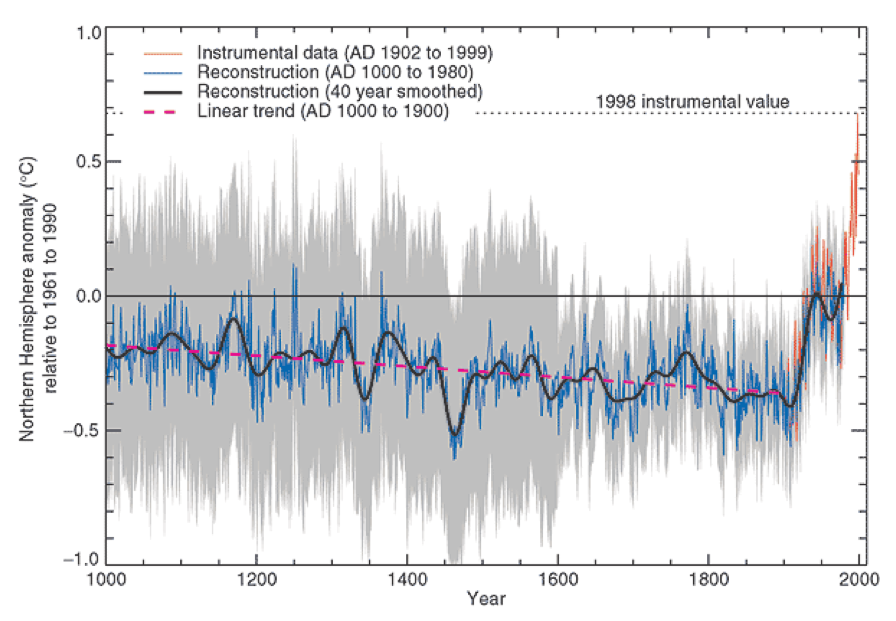
In the last issue of Science, a significant extension in our knowledge of the changes in the Earth’s average temperature since the last glacial period has been provided. Prior to this report, temperature changes over the last millennia up to the present time had been reported by several research groups. Those measurement led to what became known as the “hockey stick” shown below.

IPCC_2001_TAR_Figure_2.20

While the uncertainty of those proxy temperature measurements of several centuries ago were relatively large , those of the more recent measurements were much better and these clearly indicated a rapid increase in global temperatures in recent decades.

Marcott et al., Science (2013) have now merged the above historic temperature record with the additional proxy measurements going back approximately ten millennia, as shown by the following figure.

regemcrufull

These additional measurements put the temperature changes of the last millennia into greater perspective and show that the present average temperature of the Earth is roughly the same as the highest temperatures previously observed over the entire Holocene. They also show that the rate of our present temperature rise is far greater than any ever observed during the Holocene.
For even greater perspective, these new measurements have been combined in the last figure shown below with other measurements going still deeper in time to the final stages of the last glacial period about 20 millennia ago (green line).  In this figure our expectations of future temperature increases extending up to the year 2100 have also been included and are shown in this figure by the red line:

Shakun_Marcott_HadCRUT4_A1B_500

This figure provides a complete perspective of the temperature changes that have occurred during the period of time slightly before and after human civilizations first began in about 6,000 BC and before and after fossil fuels first began to be used extensively for energy production in about 1850 AD. The pattern of change thereby observed over the entire Holocene does indeed resemble a wheelchair.

Bottom line: The sharp rise in measured temperatures over the Industrial Age clearly suggests that something unprecedented over the entire Holocene is now occurring. Moreover, calculations of the expected effect of increased levels of greenhouse gases is in agreement with these recent temperature rises and this, in turn, lends support to the expected effects on temperature of business-as-usual means of energy production if they continue throughout the 21st century.

As they say, that last picture is indeed worth a thousand words, so need I say more? I don’t think so – other than to remind everyone that a temperature rise of 3 degrees Centigrade above present levels is thought to be entirely incompatible with existing forms of human civilization. In addition, a temperature rise of that magnitude is thought to be likely to set in motion huge additional emissions of naturally accumulated reservoirs of methane and carbon dioxide – which would very likely cause additional “run away” and irreversible temperature increases well beyond those predicted by the red line.

Posted by: ericgrimsrud | March 29, 2013

The “All of the Above” cop out

When discussing energy policies in the USA, how many of our politicians have you heard saying that they favor “all of the above” approaches to energy production – meaning that they support the development of the alternates, such as wind, solar, hydroelectric and geothermal, as well as continued development of the conventional fossil fuels, including gas, oil, coal, tar sands, and shale (fracking)? My guess would be that you have heard this from almost all of your elected officials from the Democratic Party and many or even most from the GOP. To be specific, this is in fact the official position that has been taken by both of our Democratic Senators, Max Baucus and John Tester, our Republican Representative, Steve Daines, and our Democratic President, Barack Obama.

Apparently, this position is favored by most politicians because it provides something for everyone in all of the energy sectors. The fossil fuel sector goes along with it because it keeps fossil fuels in the mix and they know that the fossil fuels will remain financially competitive as long as the environmental costs of their use are not recognized by government officials. Those of the alternate energy sector are generally pleased with the “all of the above” attitude because it provides them with the financial support that their new and generally still more expensive technologies require in order to survive in the energy business.

So what’s wrong with this picture? Everyone is happy, right? And the elected officials do not have to worry so much about strong opposition from either sector in their next election cycle, do they?

What is wrong with this system is simply and frankly that it does not end up addressing the fundamental cause of climate change. The only score card for monitoring progress in that endeavor is our annual measurements of the greenhouse gasses in the Earth’s atmosphere. The main contributor to man-caused global warming is carbon dioxide and its atmospheric concentration increases annually at a rate exceeding two parts per million. In the last year, its concentration increased by 2.6 parts per million, the largest ever recorded. The other of our most problematic greenhouse gasses is methane and its atmospheric concentration is increasing at an even more alarming rate. Part of this increase in methane is surely due to our increased exploration and use of natural gas deposits and some of it might be due to increased emissions from frozen forms of methane as our Artic regions continue to warm up.

In refusing to discuss or even mention the downsides of increased fossil fuel use, our elected officials are doing a great disservice to their constituents. They are pretending to not know about these environmental downsides and “cop out” of any discussion of them – it would appear – simply in order to avoid making political enemies within the energy sectors. They know as well as I do that a carbon tax (or carbon fee) should be assigned to all fossil fuel use ASAP, but they do not yet have the courage to do this right thing.

In short, the “all of the above” approach is not solving the great environmental problem of our times. This approach to our energy future is little more than a short term cop out – it will not allow us to have an acceptable longer term future. At the very least our elected officials – who are all certainly intelligent enough to learn and understand the real science behind this problem – should also include the downsides in their upsides-only presentations of “all of the above” energy plans. By not doing this, they are being irresponsible and, in fact, insulting to a public that needs to improve its understanding of all science, both in its schools and even more importantly on its streets ASAP.

Posted by: ericgrimsrud | March 18, 2013

Welcome to Feelandia

The failure of mankind to recognize and respond to the scientifically clear threat of man-cause global warming does literally blow my mind. I have a hard time understanding why mankind can be so utterly stupid on a subject which will have such an enormous detrimental and perhaps even fatal effect on our children and grandchildren. While I recognize that the general population is not universally well-educated in the various fields of science and the area of climate science, in particular, it amazes me to see how they disregard the recommendations of those who are experts in that area. Certainly, a major reason for this is the humungous snow job that is being done to the intellect of the general public by the omnipotent fossil fuel dynasties that have dominated life on our planet for many decades. But part of the reason is also related to the notion among many that “feelings” and “personal preferences” and “personal opinions” have anything whatsoever to do with what Mother Nature will do in the future in response to the impacts of man.

In order to further explain what I just said, I could go on, but instead will refer you to Peter Hadfield’s U-Tube video that does this much better than I can. Please do have a look at: http://www.youtube.com/watch?v=OjD0e1d6GgQ

Posted by: ericgrimsrud | February 25, 2013

Politicians and their personal views on climate change

Should politicians be allowed to rely on their own personal opinions on the subject of climate change? While it is clear that ordinary individuals and even newspaper editors have no obligation to the public to go beyond their own personal views on this topic, do government officials have that obligation? I believe they do.

Government officials, unlike ordinary citizens, are invested with the power and responsibility to prevent or minimize harm to the people they serve. And just as that is a point of fact, another fact is that mainstream scientists of our country and all of our official scientific organizations have concluded that the constituents our politicians serve are causing or contributing to the global warming problem. Thus, government officials have much more responsibility than the average citizen to understand and represent the state of climate change science as explained to them by our country’s official scientific organizations. So when they are put on notice with respect to our country’s best scientific evidence, should they be allowed to use their own contrarian private opinions on climate science as a justification for not taking action?

I don’t think so. Unlike almost all other endeavors in life, there is only one correct opinion on any topic in all fields of science. That is because Mother Nature does things only one way – Her way. The fields of science exist in order to find out what Her way is. If we come up with differing opinions on any given scientific topic only one of them can be correct. Knowing this, President Lincoln created the National Academy of Sciences in 1863 in order to have our country’s top scientists evaluate all of the science available on any given topic of national importance and provide the government with their assessments of it.

Nevertheless and as we all know, many politicians still tend justify their actions on the subject of climate change based on their own uniquely personal views of the subject. Both local and national examples of this abound. Thus, whenever this occurs, is it not the responsibility of the citizens and media of our country, at the very least, to demand that these politicians explain their contrarian views and answer the following sort of questions.

1. What specific scientific references and sources do you rely upon to conclude there is still a serious scientific dispute going on about whether or not human actions are causing dangerous climate change?

2. For what reasons do you disregard the likelihood that humans are causing dangerous climate change as has been concluded by our National Academy of Sciences, all of our major scientific organizations, and about 97 percent of the individual scientists who do peer-reviewed research every day on the subject of climate change?

3. If you claim that the US should not adopt climate change policies because of the ever present uncertainties that accompany all physical systems of any complexity, are you arguing that no action on climate change should be taken until there are no longer any uncertainties?

4. Do you think it fair and appropriate to ask those who continue to emit greenhouse gases at levels that may be dangerous to assume the burden of proof that their actions are safe?

5. Do you encourage the same lack of respect for the professional scientific organizations of our country in our public schools that you have chosen to exhibit in your own service to the public?

Thus, I encourage the media throughout the USA and elsewhere to put questions such as these to politicians who do not accept the prevailing consensus scientific view of our country on climate change – and then publish those responses. Given the extreme importance of this issue, the public deserves to see both the wisdom and folly behind those views, do they not? Who knows, the exercise might even give those politicians something to think about.

Posted by: ericgrimsrud | February 21, 2013

On the unwarranted hubris of mankind and Matt Ridley

A common reason for denial of the threat posed by AGW is related to man’s gross overestimation of his own historical experiences on this planet. One often hears, for example, expressions such as “we’ve been through some tough times before and we’ll will surely meet this challenge just as we have before”, or “I’ve heard these doomsday scenarios before and they never amounted to anything”. Statements such as these give the impression that man thinks he has been around a long time and has gained a great deal of relevant wisdom. He tends to think that he is prepared to solve just about any new problem he might be faced with and certainly is not going to be “fooled” by yet another cockeyed prediction of impending doom.

The great flaw in this line of thinking is that the total sum of all human experience and knowledge has been acquired only over an exceedingly short period of geologic time. Whether one views that period of man’s education concerning his environment to extend back 100 years to the beginning of the 20th Century, 240 years to the founding of our country, 2,000 years to the Roman Empire, or 10,000 years to the very beginning of human civilizations, the length of all of those periods constitute little more than a tick of the clock on the geological timescale. The lessons we have learned during these exceedingly short periods of time have definitely not prepared us for the global warming problem we face today.

No comparable changes in the Earth’s energy imbalance as is now being caused by AGW have ever occurred before in the recorded history of man. Nor have such changes occurred in the roughly three million years of glacial / interglacial oscillations prior to the Industrial Age of man. Therefore, if humanity hopes to maintain the environmental conditions that made his present state possible, it is essential that he realizes he has never faced a problem anywhere close to the magnitude and global scope of the AGW that his own presence has caused. It is also essential that he realizes that he will not find solutions to this problem in the “bag of tricks” he has acquired from the past. The fact that man has previously solved much less challenging problems is no reason to think he can be cool, relaxed, and confident in approaching this one. In addition, he can no longer be confident of even our immediate future largely because he has already ignored the problem for far too long and time for addressing it is running out.

Yet, the conclusions drawn by Matt Ridley in his latest book entitled “Rational Optimist” are exactly the opposite. That is, Mr. Ridley’s basic message is, “don’t worry, be happy, we’ve been through some similarly tough times before”. Thus, Ridley provides the perfect example of the unwarranted hubris of man. The only reason his opinion matters is that he is a well known and generally respected public figure. His area of scientific specialization was originally in the biological sciences and he is the author of the widely read book “Genome”. He is also a writer of many scientific articles for public magazines and is a (failed) businessman. Perhaps because of his public notoriety and the recent publication of his new book – which some apparently think is about the science of climate change – the Wall Street Journal unwisely published the opinion piece that I summarized in my previous post (called the BAU / Happy Science Approach to AGW).

The fact is that Ridley’s book, the Realistic Optimist, “is not about the science of climate change” – those are Ridley’s own words in Chapter Ten. It is instead little more than an account of the history of mankind in addressing some selected problems in the past (it will be noted that he does not dwell so much on the numerous failures of some once prosperous civilizations). After doing that, Ridley then takes the giant leap of concluding that there will also be a smooth continuation of prosperity in the future due to the ingenuity of man – regardless of the problem presently posed by AGW. Again, his argument is simply that mankind will be able to solve the AGW problem because he has solved other problems before. That’s it. There is no more to his “scientific argument” than that. Thus, Ridley offers the gullible of the world yet another view of “happy science” which is almost completely void of science.

I would not have been entirely surprised if in his book Ridley had referred his readers to the song and wisdom portrayed in the character “Bloody Marry” in the movie, “South Pacific” (see it at http://www.youtube.com/watch?v=JwIddYGse9g). It is truly delightful and makes the argument for optimism san science much more persuasively than does the “Realistic Optimist”. After all “if you don’t have a dream, how you gonna have a dream come true?” If I were a Denier, I think I would make this my theme song – the sincere wish for a happy life provided by a simple woman with no ulterior motives other than the welfare of her daughter – far more convincing than a pseudo scientist’s banter so obviously connected to his financial or political preferences.

In assessing Ridley’s book, a couple of thoughts should immediately erase any real sense of optimism he might manage to instill in the reader.

One is that he views the public, including its scientists, to be split into two groups. One group, in which he includes himself, are the optimists and the other are the pessimist. I have lived my entire life working in the field of science and have not noted such sharp distinctions among my colleagues. Most scientists, it seems to me, do their work largely by “following their nose”, so to speak. That is, they follow the thread of science that interests them and let the cards fall where they may. Sometimes the results provide potentially “good news” and sometimes they do not. In my own work back in the ’70s and 80’s, for example, my research group sometimes discovered new man-made chlorofluorocarbons (CFC’s) in the background atmosphere and sometimes discovered naturally-occurring, chlorine-containing compounds. The CFC’s were tied to man’s detrimental impact on the Earth’s stratospheric ozone layer and the chlorohydrocarbons generally reflected natural causes of ozone depletion. Thus, our measurements provided both “good news” and “bad news” concerning the chemistry of stratospheric ozone depletion. Usually new insights do provide reasons for both an improved world and for concern. Both should and generally are considered. Ridley’s bipolar view of scientists suggests to me that he thinks most professional scientist are pessimist. This, in turn, very strongly suggests to me that he is no longer a scientist himself and does not know that community.

And there does appear to be a very good reason why Ridley’s book has very little real science in it. When he does offer comments of a real scientific nature, he quickly reveals his weak understanding of the basics involved. In my previous post, I commented on his poor understanding of the Earth’s system for temperature regulation as revealed in his recent WSJ article and will not repeat those assessments here. In Chapter 10 of his book, however, he also holds forth on the benefits that increased atmospheric CO2 might also provide for life in our oceans. In particular, he suggests that increased CO2 levels might be good for our shelled critters and our coral reefs. Conventional wisdom (as well as that related in any General Chemistry textbook) suggests that the acidification of any aqueous solution would increase the solubility of CaCO3 in that solution. This, of course, would make it more difficult for shelled critters to produce their own protective CaCO3 shells in sea water. Ridley argues, however, that the higher levels of atmospheric CO2 would have the opposite effect for a reason that he suggests has been overlooked by professional oceanographers. In support of this game changing suggestion, he provides only a single peer-reviewed reference while the journals are full of evidence to the contrary. Thus, is appears that he is very content to throw out any random thoughts he can find in order to add a bit of doubt into the lay-readers mind concerning a very well-established detrimental effect of increased CO2 levels. In short, Matt Ridley offers little more than off-the-wall suggestions that help create his view of happy science.

Ridley’s book reminds me of another book that was widely read by the public several years ago. I am now referring to Michael Crichton’s novel “State of Fear”. Mr. Crichton (deceased) was one of America’s most successful and popular writers of science fiction. This book was about a self-important public figure who hyped the science of the global warming in order to further the ends of a group of distinctly evil eco-terrorists. The inevitable conclusion of the book was that global warming is a non-problem. In private interviews, Mr. Crichton also admitted to his own very strong personal doubts about the notion of AGW, and therefore, became a useful “reference” for the denial movement. Of all the authors of articles and books on the subject of climate change, Michael Crichton is the only one I know of that was invited to the White House for a one-on-one visit with President George W. Bush. While I had also admired the life work of Mr. Crichton, I hoped that his invitation by President Bush was not the result of his contributions to the subject of climate change. As evidenced by Matt Ridley’s recent appointment to the House of Lords in Great Britain, he appears to also be highly regarded by the leadership of his country. In his case, also, I hope this high level of esteem has nothing to do with his “work” in the area of climate science. Due to his strong affiliation with the Conservative Party of GB, however, I fear that it might be (I don’t know for sure, but suspect that the conservatives of Great Britain might not be any more scientifically literate than those of ours).

In closing this post, I’ll let Mr. Ridley have the last word by directing you below to a short video featuring him and his ideas concerning the future of our planet. In viewing it, you will understand why his message is so well received by many BAU advocates of the world, including the specific organization that sponsored this video. You will also note, however, that the science of climate change, including the words, carbon dioxide emissions, are not even mentioned. That, in a nutsell, is my beef with Mr. Ridley. He is suggesting that the science will take care of itself if we just let the economic motivations of people continue to do its thing – as indeed, it almost always has – isn’t that how we got to our present state?

This video can be seen at http://perc.org/articles/environmental-optimist.
Posted by: ericgrimsrud | February 13, 2013

The Business-As-Usual / Happy-Science approach to Global Warming

I believe that a free market generally provides an excellent means of solving problems – when it is fairly applied and all of its downsides as well as upsides are carefully considered. As we know all too well, however, often the downsides are not adequately considered if they are of a longer-term nature than the upsides. Often those potential downsides are then dismissed with the overly optimistic views that “something will come up” or “we’ve been through some tough times before” with the assumption that we will be able to address those long-term downsides later when they become more apparent. So it is with the “Great Anthropogenic Global Warming Debate” that policy makers and Business-As-Usual advocates are presently having. The BAU group embraces a distinctly unfair form of the free market system – one that allows a continuation of fossil fuel use without payment of a fee for the disposal of waste CO2 into the atmosphere. They believe that we should continue to do this until the alternate, non-CO2-emitting forms of energy production becomes financially competitive with fossil fuel use – a condition generally thought to be about 50 years off.

For more than a decade, this has been the argument put forward by the Swedish economist, Bjorn Lomborg, and, of course, the fossil fuel industries love him. We now know, however, that we are running out of time for an effective response to AGW – while the emissions of CO2 continue to increase exponentially every year (see my recent post called “Our Greatest Immediate Challenge “). So while Lomborg’s plan might have had great merit if proposed about 50 years ago, there is no longer sufficient time to adopt it. Since Lomborg’s plan is considered untenable by the legitimate scientific communities, the forces for BAU now invariably accompany this plan with one of various “happier versions” of climate science – usually articulated by an amateurish “in-house” pseudo-scientist. Their inadequate and minimal-action approach to addressing AGW is very much alive throughout the USA and certainly in the state of Montana.

As a Montana example, let’s first consider the version of happy science provided in the 2010 issue of the Montana Treasure State Journal, the official publication of the Montana Petroleum Association, pages 28-32 (see: http://www.montanapetroleum.org/assets/PDF/articlesReports/2010-Treasure-State-Journal.pdf.) This “lesson” in climate science (entitled “The Earth’s Atmosphere Needs More Carbon Dioxide”) is provided by a semi-retired oil executive named H. Leighton Steward who claims to have morphed into a climate science expert during his recent retirement years. By his use of a childish model for CO2’s effect on temperature, one that was abandoned in about 1940, he “shows” that the temperature of the Earth cannot rise more than about 0.2 degrees C even if CO2 levels are allowed to increase without any restraint to levels as high as 1,000 ppm or more! Apparently, that bit of “great news” passes for real science at the Montana Petroleum Association. For the last couple years, I have offered the MPA an opportunity to upgrade their knowledge of climate science, but they have shown no interest. Some of you might have also noted that Mr. Steward is presently pushing his view of climate science at the national level by using his Houston associations with a group of retired NASA has-beens. (see http://www.businessinsider.com/nasa-scientists-dispute-climate-change-2012-4).

Another example of this mating of BAU economics with happy versions of science was recently provided on the national scene by the Wall Street Journal. On Dec. 18, 2012, they ran an opinion piece entitled “Cooling Down the Fears of Climate Change” by Matt Ridley, a British author and businessman with a strong background in biology. He does indeed have a strong professional and educational background in the biological sciences and his book, “Genome” has been very well-received. Unfortunately, in his WSJ article, he ventured into territory that he obviously knows relatively little about in order to offer his own version of happy climate science. Using another British businessman named Nic Lewis as his primary reference along with an assortment of other cherry-picked and sometimes misrepresented items from various literature sources, Mr. Ridley informs us that “it remains highly plausible that there is no net positive feedback from water vapor” as CO2 levels rise (it should be noted that the opposite has been thought to be the case over the last 116 years ever since Svante Arrhenius first contemplated the atmosphere’s effect on surface temperatures way back in 1896). Thus, he concludes that Mr. Lewis’s observational data “would be pointing at only about 1.2°C of warming for the end of the century”, as opposed to the 3° to even 5°C increase predicted by most climate scientists today if BAU continues. Moreover, Ridley suggests that “a cumulative change of less than 2°C by the end of this century will do no net harm. It will actually do net good”. The implication of Mr. Ridley’s unique view, of course, is that we can continue to let the existing BAU market place do its thing and the planet will be just fine, if not actually improved. In his WSJ piece, I also noted that Mr. Ridley’s high regard for his main reference, Mr. Lewis, appeared to be based on the fact that Mr. Lewis has served as a reviewer of documents produced by the IPCC. Mr. Ridley failed to point out or perhaps does not know, however, that the IPCC review function can be served by anyone who wishes to volunteer for that service – no credentials or professional experienced are required. Not surprisingly, the remarks Mr. Ridley made in his WSJ piece have been either debunked completely or ignored by the scientific community. They have, however, been embraced by the forces for BAU. After all, here we have a renowned scientist telling us that all will be OK with BAU – while displaying no regard at all for the far more likely possibility that he is entirely wrong!

Finally, I will share here some of my recent interaction with a friend (perhaps now a former friend) who presently works at the head of what is reported to be one of our nation’s largest think tanks dedicated to improving environmental quality through market-based approaches. I had hoped that I might find in this person a more professional blending of modern climate science with market approaches. Sadly, I have so far been disappointed, as explained below. While I would assume that my former friend is proud of his views, I will honor his request here that he not be identified. I will also point out that I invited my friend to correct any misunderstandings I might have had of his recent communicatoins with me and, so far, he has offered no such corrections.

My recent exchanges with my friend began shortly after I heard him being interviewed on a radio program dealing with the AGW issue. On that program, my friend said that he does not study the energy policy knowns as a “Carbon Tax” because he does not beieve a carbon tax has any chance of being instituted in the USA. Upon then asking my friend why he held this view, he explained that he does not believe that any energy policies could make any differences with respect to any outcomes of AGW. This comment both surprised and disappointed me because I would have thought that a carbon tax would surely reduce CO2 emissions and, therefore, would also reduce future temperatures – as expected by me and about 98% of other professional climate science researchers. In addition, my understanding is that the small carbon tax that has been applied in Australia over the last couple years has resulted in a significant reduction in CO2 emissions in that country. Therefore, the basis for my friend’s statement appeared to me to be that he doubted the prevailing scientific view of AGW – that the increased levels of CO2 caused by BAU would, in fact, result in dangerously high temperatures. He explained to me that while he was not a denier of AGW, he does consider himself to be an “agnostic” with respect to the science involved and tends to favor the scientific view expressed by Matt Ridley, whose WSJ article I discussed above. My friend recommended to me both Ridley’s WSJ article and his new book, “Rational Optimist” which I then purchased and read (in a separate post to be entitled “The Hubris of Mankind and Matt Ridley” I will also discuss this book). After providing my feedback to my friend concerning the two sources of information he recommended and upon trying to expand his scientific knowledge to include some peer-reviewed versions of the science, my friend became distinctly irritated and declared that he saw no point to our further discussions of the science involved in climate change and signed off. Like most other BAU market advocates I have tried to approach, he is apparently very content with the happy version of science he has found in the “wisdom” displayed by his libertarian friend, Matt Ridley. My friend’s hope, I can only guess, is that Mother Nature cares about the political and economic ideologies of human beings. Unfortunately history has shown that the field of science has typically provided our best predictions of what She does.

In summary, all of these experiences and many more of the same nature have reinforced my impression that BAU market forces and happy versions of science go hand-in-hand when it comes to the subject of AGW. Personally, I suspect that many of these BAU advocates, such as my friend who I happen to know relatively well, are actually aware of some of the best science available. I also suspect, however, that many of them are equally aware of a universal downside of being somewhat too well-informed. That is, with greater knowledge, one might then be obliged to act more responsibly and doing so might prove to be contrary to one’s financial or political goals. Indeed, one can often do much better financially if one finds an excuse for not knowing so much. As Mark Twain once observed “no one ever went broke by underestimating the intelligence of the public”.

Posted by: ericgrimsrud | January 17, 2013

The last 16 years

The Deniers of AGW often argue that man-caused global warming is not occurring by using, as best they can, the variations of temperature that occur for natural reasons over the relatively short term time scales of either one year or even a decade. For example, back in 2009, we heard the Deniers repeatedly claim that global cooling had occurred during both the previous year and the previous decade. Both of these claims were correct only in the sense that the average temperature of the Earth did go down in 2008 and that the temperature of the specific year 10 years earlier, 1998, just happened to be anomalously high. So if one used only the temperatures for the years, 1998, 2007 and 2008, both of their statements could be said to be correct in a very narrow but misleading sense. Inspection of all of the data over the decade prior to 2008, showed quite clearly that the Earth had not, in fact, detectably cooled over that decade. They were simply cherry picking specific years in order to make their case.

When the temperature for 2009 became available, however, and it showed a distinctly higher temperature than 2008, I noted immediately that the Deniers then dropped their argument described above and moved on to other bogus claims. The one we most frequently hear today is that the average temperature of the Earth has not increased over the last 16 years.

Rather than punt this one out of the ball park also here, I will instead refer the interested reader to a short video recently produced by Skeptical Science – which does this most clearly. It can be found at http://www.skepticalscience.com/16_more_years_of_global_warming.html

In addition, another even more important fact must be recalled: More than 90% of the extra heat we are receiving from our increased levels of GHGs goes into the oceans of the world and only minor portions go towards heating the atmosphere and the continents. For a complete explanation of this, see http://www.skepticalscience.com/australian-pachauri-global-warming.html Temperature measurements of the ocean clearly show the huge amounts of energy that has been deposted there in the last several decades. And remember, while it takes a long time to warm up the oceans, it will also take a long time for them to cool back to pre-industrial levels – from that perhaps now imaginary point in the future when we mananage to bring CO2 levels back down to pre-industrial levels. Thus, when ever we do get serious about addressing climate change, we will have to deal with the following two formidable facts. It takes a very long time to rid the atmosphere of its excess CO2 and it takes along time for the oceans to release their excess heat.

Posted by: ericgrimsrud | December 25, 2012

AGW is our most important “short term” problem

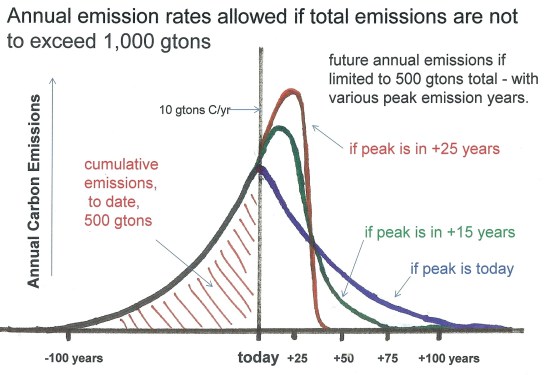
Yes,  this is true as indicated in the figure below:

scan0005

These are a serious of curves that follow the information provided by Kevin Anderson four posts ago.  I have drawn them myself here in a manner that hopefully conveys his major point.  That is, addressing AGW is really a short-term and immediate issue.

The point being made here follows on the heals of a previous Post called, “Its the Cumulative Emissions, Stupid!”.  First note the known emission rates prior to TODAY shown by the black curve in the figure. The area under this curve, shown by red hash marks, represent the amount of Total Emissions from the beginning of the Industrial Period up to the present. We know that those total emissions were about 500 gtons of carbon (in the form of carbon dioxide). We also know that those emissions have and will cause about 1.0 degrees C of warming (of which about 0.8 C has already occurred). If we hope to limit total Industrial Age warming to a maximum of 2.0 C, it is widely thought that we must limit total emissions to about  1,000 gtons carbon. That is, we must not emit more than another 500 gtons C in the future. Because the excess CO2 stays in the atmosphere so long (several centuries), it does not matter when in the next century or two we emit that 500 gtons of additional carbon. This is simply the total we will be allowed to emit in the future if we want future warming to be less than 2 degrees C (3.6 degrees F)

Now what if we immediately stop our increase in emissions today and then decrease them continuously as shown by the blue line in the figure. With this plan we would have to drasctically reduce annual emissions as shown in the next 100 years. Because the blue line is the mirror image of the black line representing our known past emissions, the area under the blue line would also represent 500 gtons of carbon. Therefore, by this plan our objective of limiting total emissions over all time since the beginning of the Industrial Period would be achieved. This would not be easy, however.   It would be very challenging to reduce annual emissions as shown by the blue line .  Nevertheless, we will see also see that this would undoubtedly provided our easiest route if we want the reduce total warming to 2.0 C.

Next, let’s move on to consider future annual emissions as represented by the green curve. This one is more realistic in that it shows that annual emissions are still increasing exponentially today. That, indeed, is what is presently happening due a continuation of Business as Usual in the developed countries due to the increased globalization of world markets and especially that of China.  A CO2 molecule emitted in China, of couse, has the same effect as one emitted anywhere – it is the Global Cumulative Emissions that count. For the green curve, I have assumed that annual emissions will finally peak and turn around in about +15 years from now. Then I completed the downward motion of the green curve so that the total area under the green line is again the same as that under the black curve – that is, a total area under the green curve that would again be equivalent to the allowed future cumulative emissions of 500 gtons. Note how much faster annual emissions would have to be cut following that peak year 15 years from now. Cutting annual emissions that much and that quickly would be even much more difficult than those shown by the blue curve.

Finally, let’s see what happens if we allow annual emissions to continue to increase for +25 more years as shown by the red curve.  Note that the cut in annual emissions after that peak year would then have to be literally precipitous and immediate after that peak year just 25 years hence if, again, total future cumulative emissions were to be held to 500 gtoms carbon.  That is, annual emissions of about 10 gtons per year would have to go to near zero within just a few years.  That would, of course, be practically impossible and could not be done.  In that case, we would undoubltedly have to admit that we can not hold future temperature increases to 2 degrees C. This admission is already occurring, in fact, because of the general consensus that we probably will not manage to reduce annual emissions in a manner shown by the blue or the green curves either. That is, we have perhaps already waited taoo long to limit our total emission to 1,000 gtons of carbon.
a
Nevertheless, the message of the figure we are discussing still applies. That is, if we change our goal to limiting future warming to 2.5 degrees C, for example, then our total allowed cumulative emissions would be about 1,250 gtons and our allowed future emissions would be 750 gtons instead of 500 gtons. In that case, it would still be advantageous to move the Peak Year forward in time as much as possible so that the required decrease in annual emission thereafter would be physically possible.  How and whether existing civilizations could withstand a warming level of 2.5 degrees C would be a separate and good question that would also then have to be addressed.

Botttom Line:  The Peak Year must be made As Soon As Possible and the closer it is to Today, the more feasible (or should I say possible) future required reductions in annual emissions will be.  So yes, addressing AGW is our greatest short term challenge.  We simply must begin to take forceful action on this problem right now and throughout this present decade.

Posted by: ericgrimsrud | December 20, 2012

USA temperatures for 2012

While we wait to learn what the average global temperature will be for the last year, 2012, a hint has been recently provided by the folks at Climate Progress for that of the lower 48 states of the USA  (see graph at  http://thinkprogress.org/climate/2012/12/13/1333911/mother-nature-is-just-getting-warmed-record-smashing-december-2012-hottest-in-us-history/.)  The 2012 data point shown includes most of that entire year, up to Dec 10 (the average of previous years is used to guess what the last 21 days of 2012 will be).  Note that the last value indicated for 2012 is literary “off the chart”.  It was by far the warmest year on record for the US.

One invariably reads in the deniers’ blogs in recent years the claim that the temperature of the Earth has not increased over the last decade.  We know that statement was not meaningful, however, because global temperature increases are expected to be noticeable only on a decadal basis rather than an annual basis.  Thus, it appears that the upcoming data point for 2012 will reinforce our expectations of a decadal trend of increased temperatures – at least for the lower 48 states – because the 2012 value is expected to set an all-time record which will greatly exceed all previous measurements.  Note in the figure that the new US record for 2012 is expected to be a full one degree Fahrenheit greater than the previous record set in 1998!  That would be a spectacular result that might even affect a few of the hard core deniers of the world.

Furthermore, with a continuation of Business As Usual, we can expect much greater temperature increases in the rest of the 21st Century than we observed in the 20th Century – for several reasons .  The greatest of these is that with BAU, emissions of CO2 will continue to increase exponentially.  That is, an increase in annual emissions on the order of 3 to 6% per year is expected as the financial systems of the world becomes increasingly globalized (note: a fixed percentage on an increasingly large number each subsequent year is exponential not just linear growth).  China is the leader of the newcomers to industrial globalization with others, including India, expected to follow her lead – thus joining the already developed industrial powers in creating an every larger world-wide carbon-intensive industrial market place.  Another reason for expected  increased temperature rises in the 21st Century is that in the 20th Century the cooling effect caused by sulfate particular matter (largely caused by coal fire power plants) provided a significant offset to the warming caused by the then more modest levels of greenhouse gases.  With BAU in the 21st Century, we can expect the atmospheric CO2 levels to continue to rise exponentially to much higher levels while the pollution due the sulfate-based particulates will continue to be brought under control by improved SO2 scrubber systems on power plants.  In addition, the increased CO2 levels we create every day will remain in the atmosphere for several centuries while sulfur-based pollutants will be remove by natural processes in a matter of weeks once their emissions are stopped.

Since the beginning of the Industrial Era about 160 years ago, the global average temperature has increased by about 1.5 degrees F.   With BAU, we can expect an additional increase in global average temperature of about 5 degrees F by the end of the current century, thereby raising average temperatures to about 7 F greater than the preindustrial era.  Since the temperature increases on land masses are,  in general,  expected to be almost twice those over the oceans, increases in land temperatures are expected to be about 14 degree F  higher.  Can you imagine a heat wave in New York City, for example (where the urban heat island effect is also operative0, in which temperatures reached levels 14 degree higher than those of the past?  In such a place, do you think that demands for air conditioning, for example – just to mention one commodity – could be met?  And from what power source would we get that air conditioning – more coal-fired power plant, perhaps – thus generating more CO2?

Yes, we do live in an absolutely crazy world that appears to be headed straight over various types of “cliffs”.  While the environmental cliff being discussed here is clearly the most grave, it also receives the least attention.  It was not even mentioned during our recent Presidential debates.  Most prefer not to think about it and hope against hope that our scientifically illiterate deniers are right and that our leading scientific organizations don’t know what they are talking about in this specific case.

We don’t know yet what the global temperature average for 2012 will be exactely.  That report is due out in about March of 2013.  We do know, however, that the world is steadily getting warmer and we haven’t seen anything yet compared to what’s expected just around the BAU corner.    Read More…

Posted by: ericgrimsrud | December 11, 2012

It’s our Cumulative Emissions, Stupid!

No insult intended here with this attention-grabing title, but:  After a few years now of trying to improve the public’s understanding of the global warming problem, I have come to realize that the key point in achieving that objective is to understand the single most important factor associated with future increased temperatures.   That factor is the SUM of all CO2 emissions ever caused by the combustion of fossil fuels since man first started to burn fossil fuels in large amounts at the beginning of the Industrial Age about 160 years ago.  The term assigned to this quantity is “Cumulative Emissions”.

So why is this quantity so important?  It is mainly because the additional carbon atoms we transfer from the geological world to the biological world by the combustion of gas, oil, or coal then stay in the biological world for a very long time – for approximately a millennium – and remain distributed between the atmosphere, plants and animals, and in the surface layers of the oceans with about half of that new carbon remaining in the Earth’s atmosphere.  Thus, of the about 500 gigatons of carbon that have been burned since 1850, about 250 gigatons remains in our atmosphere today.  That is why the concentration of CO2 in our atmosphere has risen from 280 to 396 parts per million since 1850 and the mass of carbon in the atmosphere has risen from about 550 to 800 gegatons over that period (note that a gigaton is equal to one billion tons).

Thus, the Cumulative Emissions of carbon over the Industrial Period have been about 500 gegatons and those emissions have increased the temperature of the Earth about 0.8 degrees Centigrade or about 1.5 degrees Fahrenheit so far.   This deceptively small increase in temperature has caused the changes we have observed to data (such as disappearing glaciers, increasing frequency of floods and drought, decreasing ice coverage of the Arctic Ocean, increasing sea levels).   Furthermore, the total amount of warming due to our cumulative emissions to date are expected to reach about 1.0 C within the next decade or two as the thermal inertia of our vast oceans is gradually overcome.  From observations such as these, we can expect that future emissions of another 500 gegatons of carbon will raise the average temperature of the Earth another one degree Centigrade so that the net temperature rise will then be approximately 2.0 C.

A rise of 2.0 C relative to the pre industrial period is now considered to be “very dangerous” and is expected to cause many very  serious problems (see the references to Kevin Anderson provided in my two previous posts).  Yet, the scientific community increasingly believes that this amount of future emissions and temperature increase can no longer be avoided.  That is, we are now so addicted to the use of fossil fuels for energy production that it will be practically impossible to prevent the future use of at least 500 gegatons more of our fossil fuel carbon.   The readily available reserves of gas and oil, alone, throughout the world add up to about 500 gegatons and we are continuously looking for more of these “relatively clean” forms of fossil fuels.  At the same time, we continue to explore the means of extracting and using the other, far dirtier forms of fossil fuels, such as coal, tar sands and shale oil.  The estimated reserves of these are thought to be far, far greater, about 10,000 gegatons.  Thus, it presently appears that the cumulative emission of carbon over the coming century is likely to be much more than  500 gegatons, as “business as usual” continues.   Thus, we are actually headed for state in which the temperature of the Earth is very likely to reach and even exceed 3 or 4 C degrees greater than the pre-industrial period.

As Kevin Anderson explained (see previous two posts), a +4 C state is generally considered to be incompatible with existing forms of civilization on this planet and might very likely set into motion additional irreversible changes that will drive temperature even higher.  I will not repeat that information here, however, and will instead return to the main point being made – that is, is to explain why the term “Cumulative Emissions” is key to understanding where we are and where we are headed.  In summary, we can expect a temperature rise of about 1.0 Centigrade for every successive 500 gegatons of carbon we burn.  We are now assured of a 1.0 C increase from our cumulative use of fossil fuels, to date, and are sure to add another 1.0 C even as we try to turn things around.  If we don’t manage to turn thing around and we continue to burn even more of our all too abundance supplies of fossil fuels, you will be able to predict the future – simply by watching the most reliable predictor of temperture increase called Cumulative Emissions.  When we reach a Cumulative Emission level of about 2,000 gegatons, you will know that we are literally “toast” having achieved a +4 C climate.

Is all of this very alarming and am I being an “Alarmist”?  I certainly hope so.  The more we have learned in very recent years, the more we have come to realize how insufficiently alarmed we have been even during the last decade.   In any case, an understanding of the term, Accumulate Emissions, will help us understand why action is needed right NOW – while annual emissions are the highest they have ever been. We are presently “using up” the lions share of our allowance for all future emissions.  Therefore, we can do the most good by reducing our present way-too-high emissions.  We should not be deceived into thinking that we will “solve the problem” later by decreasing emissions at some later date.  It our Cummulative Emissions that matter and it does not matter if we emit 500 more gegatons carbon tomorrow or whether we spread those emissions out over the next two centuries.  The result will be the same and if we do manage to limit those total future emissions to 500 getatons of carbon, we might be able to limit future temperature increases to 2.0 degress C.

« Newer Posts - Older Posts »

Categories